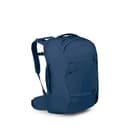
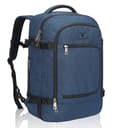
What you are actually replacing
Four things, and no pack below matches all four. Sorting them is most of the work of choosing, so here they are in the order people actually care about them.
- Expansion. The hardest to replace, and the whole reason the 45L exists. One bag that is 35 liters flying out and 45 flying home is a real answer to a real problem. In our registry exactly one other pack does it with a live price: the MATEIN 52L Expandable, published as 40L to 52L.
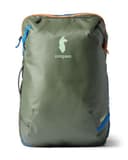
- Organization you can see.Four access doors on the 45L — rear, front, side and top — built around cubes and camera cubes sold separately. Cotopaxi and Nomatic answer this in kind, by different means: the Allpa sorts a trip behind zip mesh, the Nomatic gives each item its own structured compartment.
- Recourse.Peak Design publishes a lifetime warranty on failures that stop the bag working. Three alternatives here match it in kind — Cotopaxi’s Guaranteed for Good for the lifetime of the product, Nomatic’s lifetime warranty, Osprey’s All Mighty Guarantee — and one of them matters more than it looks, for a reason in the warranty section below.
- The published numbers. This is the quietest thing Peak Design sells and the one you will miss most. It publishes external dimensions in both modes, an empty weight, a shell denier, a bottom-liner denier and a maximum laptop size in inches and centimeters. Two of the six packs below publish no fabric and no warranty at all.
The fit table, where Peak Design is better than its reputation
Multiply the 22 x 14 x 9 inch allowance the US majors publish and you get 2,772 cubic inches— roughly 45 liters of total space, fabric and harness included. That number is worth holding onto, because it reframes the whole page: a 45-liter pack that fits inside a 45-liter box has to be built out of nothing. Published exteriors, multiplied out:
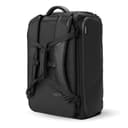
- Peak Design Travel Backpack 45L — 22 x 13 x 9.5 in (2,717 cu in). Level on height, a full inch inside on width, half an inch over on depth. Expanded it is 22 x 13 x 11 in (3,146 cu in), which is not a carry-on anywhere. Note what the standard figure means: at 2,717 cubic inches the bag is smaller than the allowance itself.
- Peak Design Travel Backpack 30L — 20.9 x 13 x 7 in (1,902 cu in). Inside the box on all three axes, and still inside at 7.9 in deep expanded. It is the only pack in this comparison that clears a strict sizer in every mode.
- Cotopaxi Allpa 42L — 22 x 14 x 11 in (3,388 cu in). Level on height and width, two inches over on depth. That is the price of 42 liters in a bag with walls inside it.
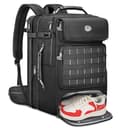
- MATEIN 52L — 21 x 13 x 9 in closed (2,457 cu in), 10.5 in deep expanded (2,867 cu in).Inside on height and width, level on depth closed — then 1.5 in over expanded. Exactly the Peak Design trade, at a budget price.
- Nomatic Travel Bag 40L — 21 x 14 x 9 in (2,646 cu in). Level on width and depth, an inch inside on height. No margin, nothing over.
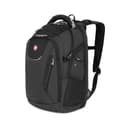
- SwissGear Travel Tech Elite — 18 x 11.5 x 7 in (1,449 cu in). Four inches of margin on height, 2.5 on width, two on depth. The only pack here with room to spare on every axis, which is what 31.4 liters costs you.
- Osprey Farpoint 40 — 21 x 15 x 10 in (3,150 cu in).Over a 14-inch width limit and over a 9-inch depth limit, on the pack we otherwise recommend most often. Width is the Farpoint’s quiet failure and almost nobody mentions it.
- Hynes Eagle 40L — 20.1 x 13.4 x 9.8 in (2,640 cu in). Inside on height and width, 0.8 in over on depth.
Depth is the entire story in this class. Height and width are cheap for a designer to respect; liters are won by going deeper, and depth is the dimension a sizer catches most reliably. If your route is a strict European carrier, start from the packs that fit 22 x 14 x 9 rather than from a liter figure.
Weight, and the thing the 400D number tells you
Capacity per empty pound, from each maker’s published figures: Hynes Eagle 40L 18.2, MATEIN 52L 15.2 expanded, Cotopaxi Allpa 42L 13.4, Osprey Farpoint 40 12.9, Nomatic 40L 11.7, SwissGear 10.5, Peak Design 45L 10.0, Peak Design 30L 8.5. Against the 7 kg (15.4 lb) cabin allowance Emirates and Qantas publish, those bags spend 14, 22, 20, 20, 22, 19, 29 and 21 percent of the allowance before you pack anything.
Here is the part that surprised us when we laid the specs side by side. Peak Design’s shell is 400D. The Cotopaxi Allpa’s is 840D. The heavier bag is wearing the thinnerfabric. So the 45L’s 4.5 pounds are not fabric weight at all — they are the frame, the anodized aluminum and glass-reinforced nylon hardware, the magnetic latches and the four access doors, which each need a zipper, a flap and a reinforced edge. Every door you can open is a seam that has to be built.
That reframes the decision honestly in both directions. If you want the hardware, the weight is not waste and no lighter bag will give it to you. If you only wanted a tough shell, you can buy more denier for less money and less weight. The full set of published empty weights on this site, from 0.16 lb to 7.93 lb, is in how much a travel backpack weighs.
The warranty clause worth reading before you buy
All three lifetime warranties here are real, but they are not identical, and the difference lands squarely on packs like these. Peak Design’s warranty covers manufacturing defects and failures that render part or all of the product non-functional, and excludes products bought on secondhand marketplaces or auction sites, along with cosmetic wear, misuse and Factory 2nds. Cotopaxi’s Guaranteed for Good covers the Allpa for the lifetime of the product with no channel restriction we can find. Osprey’s All Mighty Guarantee repairs or replaces the pack, any product from any era.
Peak Design bags hold their value and resell constantly, which is exactly what makes that clause expensive: the warranty is a feature of the purchase, not of the bag, and it does not travel with the pack. If you buy new it costs you nothing. If you were planning to find one used — a common move at this price — the thing you were buying the bag for is the thing you would not be getting. Below the premium tier the question disappears, because MATEIN and Hynes Eagle publish no warranty term at all, and SwissGear’s own warranty page puts backpacks at 3 years (6 bought direct) while its Amazon listing advertises 5 and 10 — those longer terms belong to its luggage line.
Which alternative, by reason for leaving
“Too expensive”
The Hynes Eagle 40L, and the gap is not subtle. A 40-liter clamshell with a real hip belt and compression straps, at 2.2 lb — less than half the 45L’s empty weight for the same stated volume. You give up the warranty entirely (none published), the hardware, the weatherproofing and the published spec sheet. For two trips a year that is a reasonable trade; for a bag you carry monthly it is not, and we say so on travel backpacks under $100.
“I want the expansion, not the price”
The MATEIN 52L Expandable. It publishes 21 x 13 x 9 in closed and 10.5 in deep expanded, a 40L-to-52L range, a 17.3-inch laptop compartment and three packing cubes plus a toiletry bag in the box. Read the depth figure the same way you read Peak Design’s: expanded, it is over the limit, so it is a checked size. What you give up is everything in the build column — no published fabric, no published warranty, and 3.42 lb before the included cubes go in.
“I want the organization in a lighter bag”
Cotopaxi Allpa 42L. Suitcase-style full-wrap opening, large, medium and small internal zip pockets, an 840D TPU-coated and ballistic ripstop recycled shell, and Guaranteed for Good — at 3.13 lb for 42 liters, which is 1.37 lb lighter than the 45L for roughly the same working volume. The cost is two inches of depth over the standard box and a 15-inch laptop sleeve, so a 16-inch machine is not a published fit. Which Allpa to take is settled on Allpa 35L vs Allpa 42L.
“I want a compartment for everything”
Nomatic Travel Bag 40L. It is the closest philosophical match on this page: a structured 40-liter carry-on where each thing has its own place, a dedicated padded tech section, a 16-inch sleeve matching Peak Design’s, a published lifetime warranty and an exterior that is level with the box rather than half an inch over it. It is also the heaviest fixed-volume pack we cover, at 11.7 liters per pound. We run the pair directly in Nomatic 40L vs Peak Design 45L.
“It has to carry well on a long walk”
Osprey Farpoint 40. Peak Design publishes no hip belt for the 45L and sells one only as a 30L accessory; Osprey publishes a shaped, padded belt anchored to a back panel, so load transfers into your pelvis instead of hanging off your shoulders. That is the asymmetry we keep coming back to on this site: the heavierpremium bag is the one with no published belt. No maker publishes a number for carrying comfort, so we state it as a distinction rather than a spec — the mechanism is in why your backpack hurts your shoulders. The trade is fit: the Farpoint is the worst-fitting pack on this page on published numbers.
“I am replacing the 30L, not the 45L”
Then say so, because the two packs have almost nothing in common as purchases. The 30L is a 27-liter laptop-first bag that clears every sizer; the closest thing we cover is the SwissGear Travel Tech Elite at 31.4 liters, 18 x 11.5 x 7 in and 3 lb, with a 16-inch ScanSmart sleeve that lies flat at security, an internal side-access shoe bag and a published spec sheet for all of it. It is a work-trip bag rather than a one-bag travel pack, and 31.4 liters is the honest reason why. If you want the Peak Design build in that size, nothing else we cover offers it — the real answer may be the 30L itself, reviewed in full in our Peak Design Travel Backpack 30L review.
“It will not clear my carrier’s sizer”
Check which Peak Design you have before you replace it. The 30L clears the standard box in both modes; the 45L is half an inch over on depth in standard mode and substantially over expanded. If the 45L is the problem, going sideways will not help — every 40-liter pack here except the Nomatic is over on at least one axis. Go smaller instead: the 30-liter class is on best 30L travel backpacks, and the carrier-by-carrier numbers are in our carry-on size guide.
Two things no alternative here replaces
Worth being straight about, because a page like this can imply everything is substitutable. The first is the cube ecosystem.The 45L’s interior is designed around Peak Design’s own packing and camera cubes, which are sold separately and have no equivalent elsewhere — a camera cube that zips into a side door and opens like a drawer is not a thing you can approximate with a generic set. If you bought the bag to carry a camera system, that is the purchase, and the alternatives above are not it. The second is multi-door access. Rear, front, side and top is not a feature any other pack here publishes; the Allpa and the Nomatic open wide, but they open once.
And one thing worth replacing in the other direction: if the reason you are reading this page is that you want a bag with modes but you only ever use one of them, the whole premium is wasted. A fixed 40-liter clamshell is lighter, cheaper and simpler than any expandable, which is most of why the 40L class remains the default recommendation on this site.
What we are not claiming
We own none of these packs and have not run them side by side. Every dimension, weight, denier, sleeve size and warranty term above is the manufacturer’s own published figure, read from its own page or listing on a dated visit and cited in the sources below; where a maker publishes nothing we print “Not published” rather than an estimate. Peak Design’s figures are cross-checked against an independent spec box that agrees to the tenth of an inch. There are no ratings, test results or awards on this page, because we have not run any.