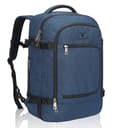
The box arithmetic, with Tortuga in it
The standard 22 x 14 x 9 in US allowance multiplies out to 2,772 cubic inches — roughly 45 litres of total space, fabric and harness included. Published exteriors against it:
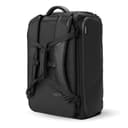
- Tortuga Travel Backpack Pro 40L — 22 x 14 x 8 in (2,464 cu in). Level on height, level on width, one inch inside on depth. Nothing over on any axis at a full 40 litres, which is the rarest result in this category and the reason the bag has the reputation it has.
- Nomatic Travel Bag 40L — 21 x 14 x 9 in (2,646 cu in). An inch inside on height, level on width and depth. Nothing over either, and the closest published match to Tortuga on this axis.
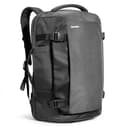
- tomtoc Navigator-T66 40L — 20.5 x 13 x 9 in (2,399 cu in). Inside on height and width, level on depth. Also nothing over, at a third of the price.
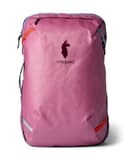
- Cotopaxi Allpa 35L — 22 x 12 x 10 in (2,640 cu in). Level on height, two inches inside on width— more width margin than Tortuga has — and an inch over on depth.
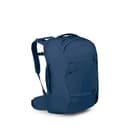
- Osprey Farpoint 40 — 21 x 15 x 10 in (3,150 cu in). An inch inside on height, an inch over on width and an inch over on depth. The loosest published fit here, on the pack with the best harness.
- Hynes Eagle 40L — 20.1 x 13.4 x 9.8 in (2,640 cu in). Nearly two inches inside on height, 0.6 in inside on width, 0.8 in over on depth.
- Tortuga Pro 34L — 20.5 x 13 x 7.5 in (1,999 cu in).Inside on all three axes with room on every one. The closest thing in our field to that shape at that volume is the BAGSMART 35L at 18.11 x 12.22 x 9.44 in — shorter and shallower-footprinted but deeper.
A rider we apply to every page like this: a published depth is the bag’s fulldepth, and a soft pack carried under capacity measures less. Tortuga’s 8-inch depth is a structural depth on a front-loading pack, which is a stronger claim than a soft bag’s — but it also means there is no squeeze in reserve if you overfill it. The same reasoning drives carry-on backpacks that fit 22 x 14 x 9.
The weight, and why you cannot have both
In litres per empty pound from the published figures: Hynes Eagle 40L 18.2, tomtoc Navigator-T66 15.1, Osprey Farpoint 40 12.9, Cotopaxi Allpa 35L 11.9, Nomatic Travel Bag 40L 11.7, and Tortuga Pro 40L 9.1— with the Pro 34L at 9.4. Tortuga is the heaviest per litre of anything on this page.
That is not a criticism, it is the mechanism. What Tortuga spends the weight on is visible in its own spec list: a height-adjustable harness, an included weight-bearing hip belt, a laminated three-layer sailcloth, lockable YKK sliders, Woojin buckles and a structured front-loading body. Structure has mass. The counter-argument matters and we will make it: a 2.2 lb soft pack with 30 lb inside it is less comfortable than a 4.4 lb pack with a frame and a belt, because your shoulders have no skeleton under them to pass the load into. The mechanism is in why your backpack hurts your shoulders.
But it is a real cost on a weight-capped fare. At 2 kg empty against the 7 kg cabin limit Emirates and Qantas publish, roughly 29 percent of the whole allowance is gone before you pack — and Lufthansa’s 8 kg makes it 25 percent. If you fly those carriers, the Hynes Eagle’s 2.2 lb buys back about two days of clothing in allowance terms. Caps by carrier are in carry-on weight limits by airline, and the full published-weight table is in how much a travel backpack weighs.
The fabric, and why no denier comparison is possible
This is the part of the Tortuga story most write-ups get wrong, including by trying to be helpful. EPX200 is not a denier; it is a laminate. Tortuga publishes its construction as three bonded layers: a 200D recycled polyester face for abrasion, a 45-degree CrossPly layer to stop tearing, and a 70D recycled polyester ripstop to strengthen seams, with waterproof coatings between the layers and a fluorocarbon-free DWR finish on the surface.
So you cannot compare EPX200 to our registry’s single-denier figures, and we are not going to.The heaviest single denier we carry is the tomtoc’s recycled 1680D PET; Cotopaxi publishes 840D TPU-coated nylon with 840D ballistic ripstop panels; Peak Design publishes a 400D shell over a 900D bottom. A 200D face sounds thin next to all of those and is doing a completely different job inside a laminate, where the tear resistance comes from the CrossPly rather than from yarn mass. Saying “200D is thinner than 840D” would be arithmetic masquerading as analysis. What we can say honestly is that nothing in our registry is a laminated sailcloth, so there is no like-for-like fabric substitute for the Pro — the nearest thing on the water-resistance axis is a roll-top dry-bag design, which is a different kind of product entirely. Our denier table across every pack we track is on most durable travel backpacks.
Organized by why you are leaving
Too expensive
tomtoc Navigator-T66 40L, at a fraction of the price, and it is the one substitute that keeps the thing Tortuga is best at: nothing over the standard box, with margin on two axes. It also names its fabric and its zipper supplier, which is rare at its price, and it is 6 litres per empty pound lighter. What you lose is the harness — no adjustable torso, no load-bearing belt on a structured panel — and the warranty drops to one year, two with registration. For a 40-litre carry-on that just has to clear a gate, it is the value answer on this site.
Too heavy
Hynes Eagle 40L, the budget pick, at a published 2.2 lb for the same 40 litres — exactly half the Tortuga’s empty weight and the most weight-efficient pack on this site at any price. It has a hip belt and compression straps, and it publishes no fabric and no warranty term, so treat it as a few-years bag rather than a buy-it-for-life one. If your trips are two a year and your fare is weight-capped, this is the rational buy.
You want the organization and the fabric story
Cotopaxi Allpa 35L. A split clamshell with zip mesh dividers so a whole trip stays visible, a published 100% recycled 840D TPU-coated nylon shell with ballistic ripstop panels, and a Guaranteed for Good warranty covering the lifetime of the product with no restriction on where you bought it. It has more width margin than the Tortuga (two inches inside a 14-inch limit) and an inch of excess depth, and it is 5 litres smaller.
The harness is why you were looking
Osprey Farpoint 40 — and this is the honest, partial answer. It is the only pack we cover with a published padded hip belt anchored to a structured back panel plus a tuck-away harness, backed by the All Mighty Guarantee, which Osprey honours on any of its products from any era. Its back length is fixed rather than adjustable, and its published 21 x 15 x 10 in is over the box on two axes. If your torso sits at the short end, the women’s-fit Fairview is the same bag on a shorter panel; that route is on Osprey Fairview alternatives.
You want one bag that will not be refused, at the same money
Nomatic Travel Bag 40L. Nothing over the standard box, a 16-inch sleeve in a dedicated padded compartment matching Tortuga’s stated laptop size, convertible to a duffel, and a lifetime warranty — at a comparable price to a Pro 40L. It is 1 lb lighter than the Tortuga and publishes no denier for its water-resistant polyester/nylon, and like the Tortuga it is a structured bag with no squeeze in reserve.
What no alternative replaces
- A height-adjustable torso. Nothing in our registry publishes one. This is the single feature most worth paying Tortuga for if you are at either end of the torso range, because a fixed panel that is wrong for your back cannot be fixed by any other spec.
- A laminated waterproof sailcloth. No registry pack is built from one, and no single-denier figure is comparable to it. If the fabric is the reason, there is no substitute here.
- The 22 x 14 x 8 in shape. Only the Nomatic 40L and the tomtoc 40L are also inside the standard box at 40 litres, and both are deeper (9 in) than the Tortuga.
And to be explicit about our position: nothing above is a criticism of Tortuga. It publishes more about its own bag than most makers in this category — three fabric layers by name, a hip-belt range in inches, a weight in two units — which is why this page can be specific at all. We simply cannot link you to one, because Tortuga sells direct and is not in the retail programme this site runs on.
What we are not claiming
We own none of these packs, including any Tortuga, and have carried none of them. Every Tortuga figure above was read from Tortuga’s own product page on a dated visit and is cited below; every other dimension, weight, laptop size, fabric and warranty term is that manufacturer’s own published figure from its own page or listing, also dated and cited. Where a maker publishes nothing we print “Not published” rather than a guess. The cubic-inch and litres-per-pound figures are arithmetic on those published numbers. We make no claim about Tortuga’s warranty term length, because the page we read states a worldwide warranty without itemising a period, and we make no claim about how EPX200 compares with any single-denier fabric. No ratings, tests or awards appear on this page.