The four things premium actually buys
1. A harness, not straps
This is the single largest difference and the one nobody photographs. A cheap pack has two padded strips of webbing sewn to a flat back panel; a good one has a load-transfer system— a stiffened frame sheet, a hip belt with structure in it, and load-lifter straps that pull the top of the pack in toward your shoulders. On a 20 lb load carried for twenty minutes, you will not notice the difference. On the same load carried through three train changes, you notice nothing else.
The mechanism is simple: a real hip belt moves the bulk of the weight onto your pelvis, which is built to carry it, and off your shoulders and lumbar spine, which are not. That transfer only works if the belt is anchored to something rigid, which is why a padded belt on an unframed bag does approximately nothing. If you take one thing from this page: the belt is only as good as the frame behind it, and torso length decides whether either works on your body.
2. A warranty someone will honor
Osprey’s All Mighty Guarantee covers any Osprey product from any era, repaired free. Cotopaxi’s Guaranteed for Good covers manufacturing defects for the lifetime of the product — a lifetime Cotopaxi defines as an estimate of how long the item can realistically keep working, not an indefinite period. Nomatic states a lifetime warranty. These are the specific reason a $250 pack can be cheaper than three $80 packs, and they are checkable claims rather than marketing feelings — you can read them on each brand’s own page, which is why we cite them below.
Compare that with the budget end of our registry, where the warranty field reads “Not published” for almost every pack. That is not us failing to look. It is the actual state of the listings, and it tells you what the manufacturer expects the product’s life to be.
3. Materials and hardware that survive
Packs fail at four places, in this order: zippers, then shoulder-strap seams, then the base fabric, then buckles. Premium bags spend money on exactly those four points — branded zips with proper coil and pulls, bar-tacked strap anchors, a heavier denier on the panel that meets the ground, and hardware that does not go brittle. None of it shows in a listing photo, and all of it decides whether you are buying one bag or three.
4. Published numbers
Premium brands publish external dimensions, empty weight and material. Budget brands usually publish a capacity and a photo. That gap matters enormously for the one question this whole site exists to answer — will it clear the sizer? — because you cannot do the fit math on a bag whose maker will not state how big it is. Our carry-on size guide is only usable against a pack that publishes its numbers.
Where the curve flattens
Here is the part a page like this is supposed to leave out. Spending goes from transformative to marginal at a fairly predictable point, and it is lower than the category wants you to believe.
Going from a $50 pack to a roughly $150–200 pack buys you all four things above. Going from there to $350 buys you refinement: nicer fabric, a more considered layout, better colors, a brand that answers email quickly. Those are real, and they are not in the same league as the first jump. If your budget is tight, the correct move is to buy the cheapest pack that has a genuine framed harness and a stated warranty, and put the rest into packing cubes and a tech organizer— which change how your trip feels far more than an upgraded shell fabric does.
And if your budget is genuinely tight, our best travel backpacks under $100 roundup is an honest account of what the budget tier gets right and where it quietly costs you.
It is worth naming the ceiling, because plenty of people shop straight for it. The Peak Design Travel Backpack 45L sits at the top of what a travel backpack costs, and what the money buys is instructive: a lifetime warranty, a recycled 400D shell over a 900D base, published dimensions for both its 35L and its 45L states, and four separate ways into the bag. It is not ranked here because of the first item on the list above: Peak Design publishes a stowable hip belt and sternum strap where Osprey publishes a framed one, and the pack is 4.5 lb empty. If load transfer is what you are buying, that difference decides it long before the price does.
One part of the premium case does hold up all the way along the curve, and it is the one you can check before you pay: the warranty. How long do travel backpacks last puts every term we have read side by side — what each maker covers in its own words, what each one excludes, and why the main zipper is the component those promises are really about.
Why these five
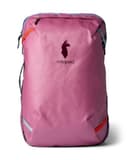
Cotopaxi Allpa 35Ltakes the top spot because it is the pack that most clearly justifies its price on things you can verify: a 100% recycled 840D TPU-coated nylon shell with ballistic ripstop panels, a clamshell layout with a mesh-lidded internal split so everything is visible at once, and a warranty that runs for the product’s lifetime. At a published 12 inches wide it is also two inches inside the sizer where the 40L field runs over, which is the practical argument that outlasts all the material talk.
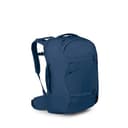
Osprey Farpoint 40 is here for the harness and the guarantee, which are the two premium attributes that survive hardest use. It is the pack we would recommend to someone who carries a loaded bag for real distances rather than between taxis. Read the long version in our Osprey Farpoint 40 review, or see it against the Allpa in Farpoint 40 vs Allpa 35L.
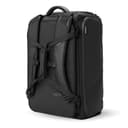
Nomatic Travel Bag 40L is the most expensive bag we cover and the one that most divides people. It is a compartment grid with a lifetime warranty: brilliant if you travel with a lot of small, specific objects, and heavy and over-engineered if you travel with clothes. It is a genuinely premium product aimed at a narrower person than its marketing suggests.
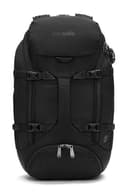
Pacsafe Venturesafe EXP35is what premium looks like when the money goes into security rather than comfort — slash-resistant mesh in the panels, locking zippers and an anchor strap. Worth it if your route genuinely warrants it, and dead weight if it doesn’t; our anti-theft roundup is blunt about which is which.
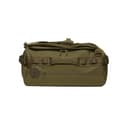
Baboon to the Moon Go-Bag 32Lis the design-led entry: a tough, distinctive carry-on duffel-pack for people who want the bag to look like something. We are including it honestly — it is a style purchase backed by real build quality, not a load-carrying system, and at 32L it is a short-trip bag.
What we will not tell you
We have not flown these around the world, and we do not run a test lab. Every figure on this page is compiled from published manufacturer specs and checked against the airlines’ own limits — exactly how we workis written down and dated. In a category where “premium” is mostly a photography budget, being clear about what we did and did not do is the only useful thing we can add. The value question itself — what the money buys, and the point where it stops buying anything — is in how much should you spend on a travel backpack.