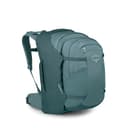
Fit first: measure your torso, not your height
Torso length is the distance from the bony bump at the base of your neck (the C7 vertebra) down to the level of the top of your hip bones. It is the number a pack harness is actually designed around, and it correlates only loosely with height — plenty of tall people have short torsos and vice versa. A pack that is too long puts the hip belt above your hips, which means the belt carries nothing and your shoulders carry everything.
Osprey and most quality brands publish a torso range for each harness size. If yours sits near a boundary, the shorter option usually carries better, because a slightly short harness still lands the belt on your hips while a slightly long one does not. If you fall clearly at the short end, look seriously at the women’s-fit version — our Farpoint vs Fairview comparison covers exactly that case, since the two bags are identical apart from the harness.
Why the hip belt is the whole game at 40L
A packed 40L carry-on commonly runs 20–30 lb. Shoulders can hold that; they just shouldn’t. A properly fitted hip belt transfers a large share of that load onto your pelvis, which is structurally built for it, and the difference over a twenty-minute walk from a station is not subtle. This is the main reason the premium packs on this page cost what they do, and the main thing budget packs approximate rather than solve.
Two details separate a real belt from a token one. First, is it padded and shaped, or flat webbing? Second, is it attached to a frame sheetthat gives the load somewhere to travel, or sewn straight to the fabric? A belt without a frame behind it stabilizes the bag but doesn’t carry it.
40L versus 35L, for a longer frame
Standard advice says 35–40L for one-bag carry-on travel, and that holds. But the choice tilts slightly for larger frames, in both directions:
- Toward 40L:bigger bodies mean bigger clothes. A large men’s t-shirt occupies noticeably more volume than a small, so the same wardrobe takes more liters. If you wear larger sizes, 35L holds fewer days for you than the reviews assume.
- Toward 35L: a 40L pack sits right at the limit, and a longer torso tends to make a full 40L pack taller in the sizer, not just deeper. If you fly strict carriers, 35L buys margin.
Our what-size guide works this through in more detail, including how trip length interacts with capacity.
The sizer reality
Every 40L soft pack on this page sits at or just past the standard 22 x 14 x 9 inch limit when packed full, and clears it when packed sensibly. That is not a defect; it’s the physics of the category. The practical consequences:
- US majors rarely gate-check a well-packed 40L soft pack.
- European budget carriers work to entirely different, much smaller free-bag numbers — see our Europe roundup before you assume a 40L flies free.
- Compression straps are your friend. Cinching a partly-full pack down changes its measured depth materially.
Check your own carrier’s current number on the carry-on size guide before you count on anything.
What we deliberately didn’t weight heavily
Color and “masculine” styling, because they don’t affect whether a bag works. Liter counts quoted without external dimensions, because capacity claims are unregulated and a “40L” from one brand is not a 40L from another. And “flight approved” badges, which mean nothing — no airline certifies bags. What we did weight: published external dimensions, harness quality, opening style, and whether the maker publishes their numbers at all. A brand that won’t publish an external dimension is telling you something.