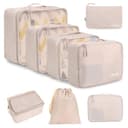
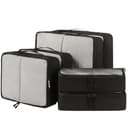
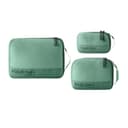
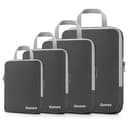
Pack for the cabin, not the case
The single change that makes cruise packing easy: decide where each cube will live on the ship before you decide what goes in it. A standard interior or balcony cabin gives you roughly a hanging closet, two or three open shelves, a small safe and a bathroom shelf you should not count on.
Map cubes to that, and the whole trip gets quieter:
- Shelf one: tops. One large cube, mesh-topped so you can see the stack.
- Shelf two: bottoms, shorts and swimwear. One large cube.
- Shelf three:underwear, socks and small items in two smalls — keeping these separate is what stops the shelf becoming a heap by day three.
- Closet:anything that must hang — the formal-night outfit, linen, a jacket. These never go in a cube.
- Under the bed: the empty suitcase, with one empty compression cube inside it for laundry.
This is why an eight-piece set is the right answer on a ship and the wrong answer in a 40L backpack. On a cruise, more cubes means more shelves; in a carry-on it just means more zips. Our packing cubes for backpacking page takes the opposite position for exactly that reason.
Formal night, and the one thing cubes cannot do
Every cruise has at least one evening with a dress code, and the outfit for it is the single item in your case that must arrive uncreased. A cube does not solve this — cubes hold shape, they do not press clothes.
Three things that do help, in order of effectiveness:
- Hang it the moment you board. Cabins are ready before luggage arrives; the first thing out of the case should be onto a hanger. Most creases fall out overnight in a humid bathroom.
- Pack it flat and last, on top of everything. A jacket or dress laid across the top of packed cubes travels better than the same garment rolled into one.
- Choose fabrics that recover. Wool, jersey and most synthetics hang out overnight. Linen and cotton poplin do not, and no packing method will save them.
The wet problem
The genuinely cruise-specific packing issue is water: swimwear, pool towels, a rain jacket from a shore excursion, and on some itineraries a wetsuit. All of it goes back into a small cabin, and none of it should meet your clothes.
Assign one dedicated cube to wet and damp things, ideally a coated or water-resistant one, and treat it as one-way — things go in wet and come out when they are dry. Never put a damp swimsuit into the cube your shirts live in; a cabin has no airflow, and a week is more than enough time for that to become a smell you carry home.
The same logic applies to shoes, which on a cruise means deck shoes, walking shoes and something for the dining room. Shoe soles belong in shoe bags, not against clothing — it is the cheapest fix in packing and the one most people skip.
Compression on the way home
Outbound, you do not need compression: you are not fighting a carry-on sizer if the case is going in the hold, and compressed clothes arrive more creased. Inbound, you are packing a week of laundry plus whatever you bought in port into the same case.
So bring one compression cube and leave it empty on the way out. It becomes the laundry cube on the ship — it shrinks as it fills, which keeps the cabin tidy — and it is what buys back the space for souvenirs on the way home. The full comparison between compression cubes and true compression bags is in packing cubes vs compression bags.
If you are flying to the port
Most cruise passengers fly first, which means the bag has to clear an airline before it has to fit a cabin. Two things follow. First, your liquids — sunscreen especially — are governed by the TSA’s 3-1-1 rule on the flight even though nothing on the ship cares; the details are in our liquids rule guide. Second, pack a change of clothes and swimwear in your carry-on, not the checked case, because a bag that misses the connection may not reach the ship before it sails.
And if you are considering doing the whole thing carry-on only, it is entirely possible for a warm-weather week — our two weeks in a carry-on guide is the harder version of the same problem.