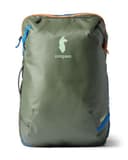
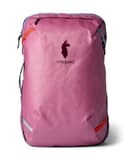
The published figures that decide it
- Capacity.35 L against 42 L, both fixed — neither Allpa expands or cinches. Cotopaxi states the 42L’s volume as 2,563 cubic inches, which works out to 42.0 liters, so the label and the cubic-inch figure agree.
- Empty weight. 2.94 lb against 3.13 lb. The gap is 0.19 lb, about three ounces, for 20 percent more capacity. Expressed as capacity per pound of pack: 11.9 L/lb for the 35L, 13.4 L/lb for the 42L. The bigger bag is the more efficient one.
- External dimensions. 22 x 12 x 10 in against 22 x 14 x 11 in. Same height, two inches of width difference, one inch of depth difference.
- Laptop.Both state a 15-inch padded sleeve; Cotopaxi describes the 42L’s as fleece-lined. If you carry a 16 or 17 inch machine, neither is your bag.
- Harness.Both publish tuckable shoulder straps and a tuckable hip belt — the feature that lets either pack be checked or gate-handled without an exposed harness.
- Warranty.Identical: Cotopaxi’s Guaranteed for Good covers manufacturing defects for the lifetime of the product. Size does not change the terms.
The box arithmetic, both ways
A 22 x 14 x 9 in allowance is 2,772 cubic inches, or about 45 liters of box. That is the figure American, Delta, United, JetBlue and Alaska all print, and it is why a 40-liter soft pack clears a US gate every day of the week.
Now run it in the other direction, which is the part almost nobody does. Multiply out each Allpa’s own published exterior and you get the volume of box it occupies:
- Allpa 35L: 22 x 12 x 10 in = 2,640 cu in = 43.3 L of box around 35 L of cargo. That is about eight liters of shell, straps and structure — and the whole bag still sits inside 45 liters of allowance by volume.
- Allpa 42L: 22 x 14 x 11 in = 3,388 cu in = 55.5 L of box around 42 L of cargo. That is over the volume of the standard allowance by more than ten liters, before anyone measures a single side.
Volume is not what a gate agent checks, which is why this arithmetic is context rather than verdict. But it tells you what you are asking a frame to accept. A 43-liter bag presented to a 45-liter opening is a plausible squeeze. A 55-liter bag presented to the same opening is a negotiation.
Where each one actually fails
Height is a non-issue: both are published at 22 inches, exactly level with the US limit, and soft bags do not grow vertically when you overpack them — they grow outward. Width is close to a non-issue too, because almost every published limit is 14 inches or wider. The 35L’s two inches of width margin only buys you something on a carrier whose limit is under 14 inches, and the strict European limits that catch travelers are tight on depth, not width: Ryanair’s priority cabin bag is 55 x 40 x 20 cm (about 21.7 x 15.7 x 7.9 in) and Lufthansa publishes 55 x 40 x 23 cm (about 21.7 x 15.7 x 9.1 in). Both are generous on width and brutal on depth.
So depth is the entire fit story, and it is where the two packs separate. Against a 9-inch US limit the 35L is one inch over and the 42L is two. Against Ryanair’s 7.9 inches the 35L is 2.1 in over and the 42L is 3.1. A soft, half-packed clamshell compresses; a hard-packed one does not. One inch of overshoot on a half-full bag is routinely absorbed by a frame. Two inches on a full bag is the case that gets gate checked, and what happens next is a predictable sequence.
Who should buy which
Buy the 42L if
- You fly US carriers mostly, where a soft bag that looks like a backpack is waved into the bin.
- Your trips are cold-weather, two weeks, or involve carrying part of someone else’s packing. Seven liters is a fleece and a pair of boots.
- You would rather have the volume and under-pack it than have the smaller bag and wrestle it. An under-filled 42L compresses better than a stuffed 35L.
Buy the 35L if
- You fly European budget carriers, regional jets, or anything where the bag is measured as policy rather than on suspicion.
- You already pack light and the extra liters would only invite more. This is the honest case for the smaller bag, and it is the most common one.
- You want the narrower profile on a crowded aisle. Twelve inches wide behaves differently from fourteen.
Buy neither if
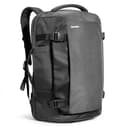
Your deciding constraint is a published number inside the box on all three sides. No Allpa meets that at any size, because the line is built deep. The tomtoc 40Lis published at 20.5 x 13 x 9 in — inside 22 x 14 x 9 on height, width and depth — weighs 2.65 lb, carries a 17.3 inch laptop and costs less than either Allpa. It gives up the mesh-divided clamshell and Cotopaxi’s lifetime warranty to do it. That is the trade, stated plainly; our dimension-first roundup is built entirely on this criterion if it is yours.
What the specs cannot tell you
Three things, and we would rather name them than paper over them. First, how the 42L carries when it is genuinely full: a tuckable hip belt is a published feature, not a measured load transfer, and 42 liters of winter clothing is a real weight. Second, whether the mesh dividers help you or get in your way — the Allpa’s whole identity is that the inside is pre-sorted, which some packers love and some find restrictive. Third, long-term abrasion on the TPU-coated panels. Our lifespan guide covers what actually fails first on a pack and what each warranty on this site says in its own words.