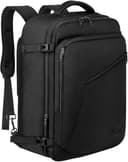
The transparency gap, which is the real ranking criterion
Multiply the 22 x 14 x 9 inch allowance the US majors publish and it contains 2,772 cubic inches — about 45 liters of total space, the bag’s own fabric and harness included. So every “40L, flight approved” budget pack is claiming nearly the whole allowance as cargo, and the only way to check that claim before you own the bag is to read the exterior the brand publishes. Here is who publishes one:
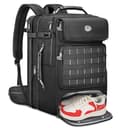
- Vancropak 40L — 19 x 13 x 7 in, 9 in deep expanded. 2.59 lb. Inside the standard box on all three axes closed, and still level on depth when the expansion is open. That is the best published fit of any pack on this page, at any price, and it is why it is our fit pick rather than our overall pick.
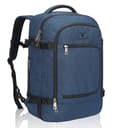
- Hynes Eagle 40L — 20.1 x 13.4 x 9.8 in. 2.2 lb. Inside on height by nearly 2 in and on width by 0.6 in, over on depth by 0.8 in. One axis out, and the soft one.
- MATEIN 52L Expandable — 21 x 13 x 9 in closed, 10.5 in deep expanded.3.42 lb. Inside the box on all three closed — which it earns by not being a 52L bag until you unzip it. Expanded, it is 1.5 in over on depth and no longer carry-on sized.
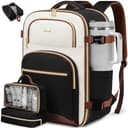
- LOVEVOOK 40L and MATEIN 40L — nothing published.No exterior dimension, no empty weight, no warranty term. The table says “Not published” in all three columns because that is what the listings say.
Treat that absence as information rather than an oversight. A brand that will not publish an external dimension is a brand that would rather you didn’t check it against a sizer. It does not make the bag bad — the MATEIN 40L is our budget pick and we stand behind it — but it does mean you are buying on trust where the Vancropak lets you buy on arithmetic. If clearing a sizer is non-negotiable, that is the whole decision; start from how to measure a backpack and your airline’s own number.
Doubling the budget changes which packs publish anything at all. The next band up, narrowed to the 40-litre class, is on best 40L travel backpacks under $100.
Weight: the one column where cheap wins outright
Capacity per empty pound is the figure that embarrasses the price list. The Hynes Eagle carries 18.2 liters for every empty pound, the Vancropak 15.4, the MATEIN 52L 15.2 expanded. For comparison: an Osprey Farpoint 40 manages 12.9, a Cotopaxi Allpa 35L 11.9 and a Peak Design Travel Backpack 45L 10.0. The cheapest bags on this site are the most weight-efficient bags on this site, because structure, metal hardware and coated shells are exactly what cost money and weight.
That is not a trivia point. Against the 7 kg (15.4 lb) cabin allowance Emirates and Qantas publish, the Hynes Eagle spends 14 percent of your allowance empty and the MATEIN 52L spends 22 percent — a difference of about 1.2 lb, which is most of a day’s clothing. The carriers that weigh cabin bags are where a budget pack quietly outperforms, and the numbers by airline are in carry-on weight limits by airline.
The two traps at this price
“Flight approved” is marketing
No airline certifies, approves or lists backpacks. The phrase appears on almost every listing in this band and means nothing beyond “we designed it with a sizer in mind.” The only thing that settles it is the published exterior against your carrier’s published limit, which is why three of the five picks above are ranked partly on whether that figure exists at all.
The expansion zip is the gate-agent trap
Three of these packs expand, and expansion is genuinely useful on the return leg and genuinely dangerous at the gate. The MATEIN 52L goes from 9 in deep to 10.5 in; the Vancropak from 7 in to 9 in. Zipped open, a bag that was inside the box is outside it. Pack to the sizer, not to the zipper — the whole category is on best expandable travel backpacks.
What $50 does not buy, in three specifics
A warranty.Not one pack on this page publishes a term. The Hynes Eagle, Vancropak, LOVEVOOK and both MATEIN 40L-class bags all render “Not published.” When a budget bag fails, the trip is over for that bag. Osprey’s All Mighty Guarantee and Cotopaxi’s Guaranteed for Good are most of what the premium field is actually selling, and the case for paying for it is in how much you should spend on a travel backpack.
A belt attached to something. Every pack here has a hip belt and most of them are webbing. A belt anchored to a structured panel moves weight into your pelvis; webbing stabilizes the load without carrying it. At 15 lb packed you will barely notice. At 30 lb on a twenty-minute walk you will notice a lot, and why your backpack hurts your shoulders explains the mechanism.
Materials you can inspect. Three of the five publish no material at all. Where the fabric is stated it is water-repellent polyester rather than nylon ripstop, and no listing in this band publishes a denier you can compare.
The $20 upgrade that beats a better bag
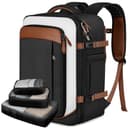
The highest-return addition to a cheap travel backpack is not a different backpack — it is packing cubes. Budget packs have fewer internal dividers than premium ones, so organization is the real usability gap, and a six-cube set closes it for the price of a lunch. Cubes also make a soft pack hold a squarer shape against a sizer, which, given that two of these bags publish no dimensions, is a genuinely useful hedge. The LOVEVOOK pick above ships with three cubes already, which is the main reason it is on the page.
Who should spend more
If you travel more than a handful of times a year, or a mid-trip bag failure would be a real problem rather than an annoyance, buy up. One band higher gets you published specs and a registered warranty — travel backpacks under $100— and two bands higher gets you a belt on a frame and a lifetime guarantee, in travel backpacks under $200. The budget field’s own head-to-head, between the two best-selling 40Ls here, is Hynes Eagle 40L vs MATEIN 40L: one has a real hip belt and no expansion, the other an expansion and no belt worth the name. That is the entire decision at this price.