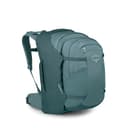
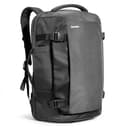
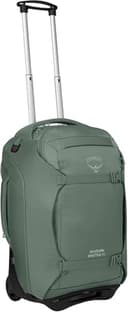
Three things get called a hip belt. Only one of them is one.
A load-bearing belt over a frame.Padded wings, a real buckle, and behind it a structured back panel or frame sheet that gives the load something to travel down. This is what the Osprey packs on this page have, and it is what makes the belt functional rather than decorative — weight cannot transfer to your hips unless something rigid carries it there. Osprey’s own spec for the Sojourn names the parts separately for exactly this reason: a stowaway harness, a backpanel and a padded hipbelt.
A padded belt on a softer back.The Hynes Eagle 40L and the tomtoc 40L both have a genuine padded belt, but a simpler back panel behind it. The belt still helps — it stabilises the load and takes some weight — and it helps less than an Osprey’s under a heavy load. tomtoc’s own trade-off, which we print in its spec table rather than smoothing over, is a simpler hip belt and back panel than an Osprey’s.
Webbing waist straps. Two flat lengths of webbing and a clip, with no padding and nothing structural behind them. These stop a pack swinging when you walk fast or run for a gate, and that is the entire job. The MATEIN 52L expandable states waist straps and we describe them as waist straps; the Taygeer 35L and the Vera Bradley Featherweight have no structure or belt at all and their listings say so.
If a listing says “ergonomic waist strap” with no mention of padding or a frame, assume the third category. The language is not regulated and the cheapest possible version of the part is also the most commonly advertised one.
Why hip belts are a 40L-and-up feature
Look at the capacity column on the table above: every one of the seven bags here is 40 liters or more. That is not a coincidence and it is not us favoring big bags. A hip belt adds cost, weight, bulk and a structural back panel to a product, and makers add it when the bag is big enough to need it. A 20L daypack with a frame sheet would be a worse daypack.
The practical consequence is that buyers who want a smaller travel pack usually cannot have a belt. Our best 35L travel backpacks page is the clearest example: not one of the five bags in that class publishes a padded load-bearing hip belt. If you want a belt, the realistic options start at 40L, which pushes you toward the sizer question we cover in the carry-on size guide. If you want a smaller bag, buy a smaller bag and accept that you will be carrying it on your shoulders — which is fine, because a well-packed 30L rarely passes 15 lb.
A belt you cannot put away is a problem twice
Two situations make a permanently attached hip belt actively annoying. The first is the overhead bin, where loose padded wings catch on everything and add an inch of unpredictable width exactly when a bag is being judged. The second is checking the bag: belts, straps and buckles are what conveyor systems and baggage-handling machinery catch on, and an exposed harness is the single most common way a travel backpack comes off a belt damaged. Our guide to checking a backpack as luggage is about that failure mode specifically.
The answer is a belt that stows. The Osprey Sojourn 45 is the clearest case on this page — its harness, backpanel and padded hip belt all disappear behind a zip panel, which is what lets it work as a wheeled bag at all. On the Farpoint and Fairview the belt can be tucked out of the way rather than zipped behind a cover. If you plan to check the bag regularly, that detail matters more than a couple of liters of capacity.
Fit, which is the half of this nobody sells you
A hip belt only works if it sits on the top of your pelvis, not on your waist and not on your ribs, and whether it does is a function of the pack’s back length against your torso length. This is why the Osprey Fairview 40 exists: it is the Farpoint on a shorter back panel with narrower, contoured straps, and it is genuinely the same bag otherwise. “Women’s” on that box means “shorter and narrower fit” — size to your back, not to the label.
Measure your torso before you buy anything on this page. It takes two minutes, it is the one measurement that decides whether the belt does its job, and it is covered in how to fit a travel backpack. The Farpoint vs Fairview comparison is the same decision made concrete on two specific bags.
Choosing between the seven
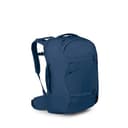
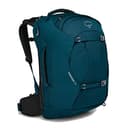
Buy the Osprey Farpoint 40 if you walk with the bag. A 40L clamshell that packs like a suitcase, a padded belt that genuinely transfers load, and a guarantee that means Osprey repairs or replaces it. The one number to check is the published 21 x 15 x 10 in: at 15 in of width it runs wide for a narrow European sizer, so measure it against your carrier before you count on it as a carry-on. Full detail in the Osprey Farpoint 40 review.
Buy the Osprey Fairview 40 if the Farpoint has ever sat too tall on you. Same clamshell, same belt, a shorter back panel and narrower straps — and, as it happens, a better published shape at 21.3 x 13.8 x 9 in, which is inside the standard 22 x 14 x 9 box on all three dimensions where the Farpoint is not. It is the quietly better buy for anyone it fits.
Buy the Hynes Eagle 40L if the budget is the constraint. It is the cheapest bag we cover with a real hip belt, it is a full 40L clamshell, and at 2.2 lb it is the lightest pack on this page by almost a pound. What you give up is durability and recourse: budget materials and zippers, and no warranty to fall back on. Treat it as a few-years bag and the value is hard to argue with.
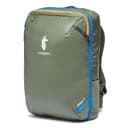
Buy the Cotopaxi Allpa 42L if you want a belt you can hide. Cotopaxi’s own spec sheet names tuckable shoulder straps and a hip belt, which makes it the one premium organizer here you can strip back to a smooth-sided bag before it goes on a conveyor — and at 3 lb 2 oz it is lighter than the Peak Design and the Nomatic. Read the belt for what Cotopaxi says it is: a hip belt, tuckable, not described as a padded load-bearing system over a frame the way Osprey describes the Farpoint’s. The real caveat is size, not comfort: Cotopaxi publishes 22 x 14 x 11 in, which is two inches over the 9 in depth limit with no margin on width, so buyers torn between sizes should take the 35L. The full argument is in our Cotopaxi Allpa 42L review.
Buy the Osprey Farpoint 55 if the load is genuinely heavy. It is the Farpoint 40 with a 15L daypack that zips off, which means the main pack carries the same clamshell and the same belt while the combination covers a longer trip. Be clear-eyed about the size: the full 55L combination is not a carry-on, so it is a checked bag or a carry-on-plus-personal-item pair. The reasoning is laid out on best travel backpacks for two weeks.
Buy the tomtoc 40L if you want most of this for less. A structured clamshell, a protective laptop compartment, a 17.3-inch sleeve and published dimensions inside the carry-on box, at a mid-tier price. The belt is real and simpler, and the back panel behind it is simpler too, so the comfort gap against an Osprey opens up under a heavy load and over a long walk. For airport-to-hotel, you will not notice.
Buy the Osprey Sojourn 45 only if you truly need both modes. It is the only wheeled bag we cover with a real suspension rather than two courtesy straps, and Osprey publishes it at exactly 22 x 14 x 9 in. It is also 7.93 lb empty, which is more than a fifth of a 7 kg cabin allowance gone before you pack, and it is the most expensive bag on this page. If the wheels are the point, start at wheeled carry-on backpacks.
The packs that are excluded, by name
These are bags the site rates well that do not qualify here, because the honest version of a feature page says what it leaves out:
- Peak Design Travel Backpack 30L.Peak Design states that the hip belt is a separate accessory and not in the box, and that there is no frame — so the load rides on the shoulders as sold. Excellent bag, and its own review says this plainly.
- Cotopaxi Allpa 35L. Cotopaxi’s spec sheet for the Allpa 42Lnames tuckable shoulder straps and a hip belt, which is why that bag is ranked above — but the 35L listing we read states neither, so we do not credit a belt it has not published. The 35L’s case is organization and warranty, which is how it is ranked on premium travel backpacks and best 35L travel backpacks.
- MATEIN 40L expandable.Its own listing concedes no hip belt worth the name — it is a shoulder-carry bag. It earns its place on travel backpacks under $100 on price and volume.
- Taygeer 35L and the Vera Bradley Featherweight. No structure and no belt, stated. Both are personal-item bags, which is the right use for them.
- High Sierra Freewheel and the Osprey Daylite Duffel 45.Both state no hip belt — the Freewheel’s straps are for short carries, and the Daylite’s load sits on the shoulders. Fine for what they are; not this.
- MATEIN 52L expandable. States waist straps, which we list as waist straps. A 52L bag at 3.42 lb empty with webbing at the hips is a bag you will feel.
How we picked
One rule: the maker or the listing states a padded or load-bearing hip belt, and the ASIN carries a live buyable price. Rank order is editorial, argued above, and based on published specifications and what each maker says the belt is attached to — not on testing we have not done, which is why there is no score column. Our full method is in how we choose.