The three ways a bag expands
1. A gusset zip
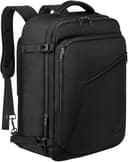
The most common mechanism: a zip runs around the body of the pack and, when opened, releases a fabric panel that adds depth. The MATEIN works this way, going from commuter-slim to a full carry-on. It is the cleanest expansion because the bag keeps its shape and its organization — it simply gets deeper.
What to watch: depth is the dimension airlines are strictest about, and it is the one a gusset adds to. A pack that measures 9 inches deep compliant can easily measure 12 expanded, which fails every sizer in existence. Depth is also what makes a pack sit away from your back, so an expanded bag carries worse as well as measuring worse.
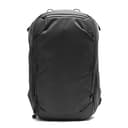
The Peak Design Travel Backpack 45L is the rare bag that lets you see that trade-off before you buy it, because it publishes both states: a stated 35L at 22 x 13 x 9.5 in, expanding to 45L at 22 x 13 x 11 in, and cinching down to 30L. An inch and a half of added depth is exactly the mechanism described above, and it is why we would fly out in the 35L mode every time. Our Peak Design Travel Backpack 45L review works through the fit math, and the empty weight that pays for it. Peak Design makes the same pack in a smaller size whose expanded depth is still inside the box, which is the quiet reason to consider it instead — see Peak Design 30L vs 45L.
2. A roll-top or extension collar
Roll-tops expand upward: unroll a fold or two and you have more height. This is the most flexible mechanism because it is continuous rather than binary — you can take half of it — and the most forgiving at a sizer, because you can roll it back down on the spot.
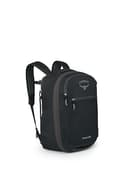
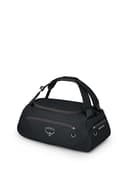
The Osprey Daylite Expandable 26+6 is the neatest example we cover: a stated 26L that becomes 32L, on a bag small enough to remain a personal item in its compact form. Our full review goes into how the six liters behave when loaded.
3. A zip-off daypack
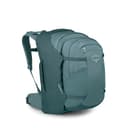
Not expansion so much as addition: a second, smaller pack clips or zips to the front of the main one. The Osprey Farpoint 55 is 40L plus a detachable 15L daypack, which is an unusually good system — you get a real second bag for day trips, and the two travel as one on flights.
What to watch: combined, it is not a carry-on and cannot be made into one. What it can be is a carry-on plusa personal item, if the daypack is small enough to go under the seat — which for most airlines and a 15L daypack it is. That reframing is what makes the system work; see personal item vs carry-on.
The rule for flying with one
One sentence, and it covers almost every case: fly out compressed, come home expanded, and check it on the way back if you have to.
The outbound flight is the one where compliance matters, because that is when your bag is being measured against a limit and you have not yet acquired anything. On the return leg you usually have laundry, gifts and a bag you no longer need to be precious about, and paying a checked-bag fee once is a fine trade for not having wrestled a fortnight into 30 liters.
The corollary matters too: if you expand, expect to be measured. An expanded pack looks visibly larger to a gate agent, which is the trigger for the sizer. Roll it back down or zip it in before you board, and check the numbers against your airline’s published limits rather than hoping.
Expandable versus buying two bags
The honest comparison, since almost nobody makes it. A 26+6 pack costs you a little weight and a zip you may rarely use. Two separate bags — a 30L pack and a 45L pack — cost you money and storage but each one is optimized for its job.
Expansion wins when the two sizes you need are close together (30L and 40L, say) and when the trip changes shape while you are on it. Two bags win when the sizes are far apart, because an expandable pack at its smallest still carries the weight, hardware and frame of its largest form. That is the hidden cost of the feature: you are always carrying the big bag, even when you are using the small one.
The alternative worth considering is the one most experienced one-baggers land on: a fixed-size main pack plus a packable daypack that weighs a few ounces. That gives you the same flexibility for less weight, at the cost of two bags to keep track of.
What we would not buy
An expandable pack whose maker publishes neither the compact nor the expanded dimensions. Several budget listings state only a capacity range, which makes the compliance question unanswerable — you cannot check a bag against a sizer using a liter figure. Where a maker publishes nothing, our spec tables say “Not published”, and on this feature specifically that gap is a good reason to buy something else. Measure any bag you already own the way a gate agent would, using how to measure a backpack.