What a business travel backpack actually has to do
Strip the marketing away and a work-trip bag has three jobs, in this order.
1. Carry the laptop where it will not get hit
The laptop sleeve belongs against the back panel, suspended off the bottom of the bag so a hard set-down on a terminal floor does not land on the corner of the machine. Every pick above publishes a sleeve size, and that number is the first filter: the Nomatic and the Peak Design publish 16 in, the tomtoc publishes 17.3 in, the two MATEIN bags publish 17 in and 15.6 in, and the Pacsafe publishes 16 in. If your laptop is a 16-inch model, a bag with a published 15 in sleeve is not a compromise; it is a bag you will end up carrying the laptop outside of.
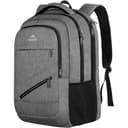
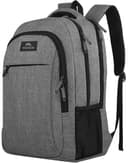
The MATEIN 17-inch bag adds one more thing worth knowing about: a lay-flat laptop section, which means the compartment unzips fully open so the laptop can be scanned without coming out. That is the feature that shortens a security lane for a frequent flyer without TSA PreCheck, and it is why a budget bag is on this page at all.
2. Keep two days of clothes flat
This is the argument for a clamshell over a top-loader, and it is stronger on a business trip than anywhere else. A pack that opens flat like a suitcase lets you lay a folded shirt on top of the load rather than roll it down a tube, and lets you take the laptop out without disturbing the clothes. The Nomatic, the Peak Design and the tomtoc all open this way. If a suit is coming with you, we work the exact fold and where it goes in the bag through in how to pack a suit in a carry-on.
3. Clear the sizer without a discussion
A structured work bag is exactly the kind of bag a sizer catches, because it does not squash. So the published external dimensions matter more here than on a soft pack. The Nomatic publishes 21 x 14 x 9 in, which is level with the standard 22 x 14 x 9 in box on two dimensions and has no give; the Peak Design 30L publishes 20.9 x 13 x 7 in, inside the box on all three with room to spare; the tomtoc publishes 20.5 x 13 x 9 in. All three are carry-ons, not personal items, on every major US carrier. The Pacsafe, at a published 17.7 x 11.8 x 5.1 in, is the one bag here we would count on going under the seat. The airline-by-airline table is in the carry-on size guide.
Choosing between the top three
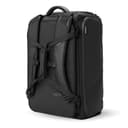
The Nomatic is the organizer’s bag: a fixed 40L with a dedicated, padded tech compartment, structured internal pockets and a strap system that lets it carry as a duffel or a backpack without changing how it packs. It is also the heaviest bag on the page at a published 3.42 lb, and the most expensive, and it makes no attempt to be light. Buy it if your trips are gear-heavy and you want every cable to have an address.
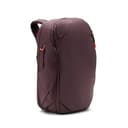
The Peak Design 30L is the opposite bet: 27 liters (33 expanded), a 16 in laptop sleeve with a separate 10 in tablet sleeve, a weatherproof recycled shell with metal hardware, and published dimensions that clear every sizer we track, including Ryanair’s priority bag and Lufthansa’s 55 x 40 x 23 cm. It holds four to five days of clothes, not a week, and at 3.17 lb it is heavy for its size. Our Peak Design 30L review goes through the fit math mode by mode. Buy it if most of your trips are two to four nights and you never want to think about the sizer again.
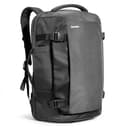
The tomtoc Navigator-T66 is the value answer and, quietly, the one with the best laptop number on the page: a published 17.3 in sleeve in a structured 1680D clamshell with YKK zippers, at a published 2.65 lb. Its harness is simpler than an Osprey’s, which matters on a long walk under a heavy load and does not matter at all between a taxi and a hotel. See how it stacks up against the premium default in Farpoint 40 vs tomtoc 40L.
The two-bag question
A lot of business travelers do not want one bag at all. They want a wheeled carry-on for clothes and a backpack that rides on top of it, holds the laptop, and goes under the seat. If that is you, the main pack above is the wrong buy; what you want is a personal-item-sized backpack with a luggage sleeve, which is the Pacsafe Metrosafe X and both MATEIN bags on this page. We cover that category on its own in best travel backpacks with a luggage sleeve.
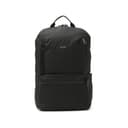
The Pacsafe earns its place on this page for a reason the other day bags do not have: it is built as an anti-theft system, with slash-resistant paneling, lockable zipper pulls and RFID-blocking pockets, in a low-key 20L that does not read as a security product. For a trip that ends in a crowded conference hall or a night train, that is worth the premium over a plain day bag. Our Metrosafe X 20L review covers what the hardware weighs and what it costs.
What we would not buy for a work trip
A hiking-derived pack. A top-loading pack with a lid and a 40L capacity carries beautifully on a trail and badly into a meeting. Its clothes come out creased and its laptop rides on top of the load. The whole distinction is in travel backpack vs hiking backpack.
Anything without a published laptop sleeve size.“Fits most laptops” is not a specification. Where a maker publishes no number, our spec table says “Not published” rather than guessing, and on a business bag that is a reason to keep shopping.
A USB port as a selling point. Several budget bags here carry a USB pass-through. It is a cable routed through the fabric, not a battery; the bank you plug into it is the thing that charges your phone, and the rules on carrying that bank matter more than the port. If you want one anyway, the packs that do it sensibly are in best backpacks with a USB charging port.
How we rank every bag on the site, and what we do and do not claim to have done with it, is set out in how we choose. Fit the bag to your torso before you fit it to your laptop; the two-minute method is in how to fit a travel backpack.