The harness, which is the whole argument
Everything else on this page is a convenience. The harness is the part that decides whether a loaded pack is walkable, and it is also the part most listings lie about by omission. Two words do the damage. “Padded hip belt” is sometimes a real belt on a structured panel, and sometimes it is a strip of foam sewn to webbing at the bottom of a soft bag — which cannot transfer load, because there is nothing rigid above it for the load to be transferred from. And “ergonomic back panel” usually means ventilation channels, not structure.
Of the packs we cover, the Osprey Farpoint family is the one that publishes a padded hip belt anchored to a structured back panel, and it is also the family with a tuck-away harness so that structure survives being checked. That single fact is why two of the six picks here are Ospreys, on a site that otherwise recommends a wide spread of brands. The budget packs on this page are chosen for water protection and price, not for carrying a load up a gradient — a 2.2 lb soft bag with 25 lb in it hangs off your shoulders no matter whose name is on it. The mechanism is in why your backpack hurts your shoulders, and sizing is in travel backpack torso fit.
Published figures, and what they mean for a trail
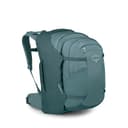
- Osprey Farpoint 55 — 55 L as 40 L + a 15 L zip-off daypack, 3.9 lb, 25 x 13 x 12 in. Read that exterior carefully: at 25 inches tall and 12 deep this is a checkedbag against the standard 22 x 14 x 9 in box, and we class it convertible rather than carry-on. The daypack is the reason it leads the page anyway — it is the only zip-off second bag in our registry, and it is sized exactly right for a day hike. All Mighty Guarantee behind it.
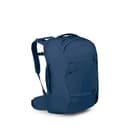
- Osprey Farpoint 40 — 40 L, 3.1 lb, 21 x 15 x 10 in, 15 in laptop sleeve. Twelve-point-nine litres per empty pound, a real hip belt, and the loosest published fit in our carry-on field (over on both width and depth). The carry-on-first answer, with no second bag included.
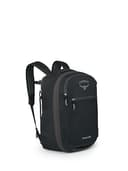
- Osprey Daylite Expandable 26+6 — 26 L expanding to 32.Osprey publishes no exterior or weight for this one, which we print as “Not published.” It is the day-hike half of the problem solved on its own, it flies as a personal item on a US major, and it carries the same All Mighty Guarantee.
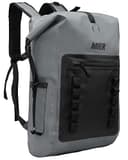
- MIER Roll Top Waterproof Backpack 30 L.A roll-top closure, which is the only closure design that is water-resistant by geometry rather than by coating — you fold the opening against itself. MIER publishes no weight, dimensions or fabric.
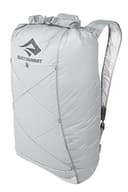
- Sea to Summit Ultra-Sil Dry Day Pack 22 L — 0.24 lb, 30D siliconized Cordura, PU-coated.Ninety-two litres per empty pound, the most weight-efficient bag on this site by a distance. It lives folded in a pocket of your main pack and comes out for the hill. Thirty denier is thin on purpose and should be read that way, not as a durability failure — the trade is argued on most durable travel backpacks.
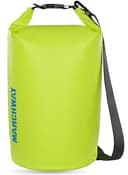
- MARCHWAY Floating Waterproof Dry Bag Backpack 40 L. A dry bag with straps, which is a legitimate design for a wet day and an honest one at the price. Nothing published beyond the volume: no weight, no dimensions, no fabric, no warranty.
Two volumes beat one big one
The arithmetic that settles most of these trips. A travel week needs 35–45 litres; a day hike needs 15–25 and wants to be light and close to the body. Carrying one 50-litre pack for both means walking a trail with a half-empty bag that swings, and carrying one 25-litre pack for both means a week of doing laundry in sinks.
So the two sensible shapes are: a 40-litre travel pack plus a packable day bag (Farpoint 40 plus a Sea to Summit Ultra-Sil, which adds 0.24 lb and almost no volume), or one purchase that contains both (Farpoint 55, where the 15-litre daypack zips off). The second is tidier and the first keeps you carry-on. Our full packable-daypack field is on best packable travel backpacks, and the day-bag field generally is on best travel daypacks.
Rain, and the difference between water-resistant and waterproof
Nothing on this page is waterproof in the sense of surviving submersion, and we would not say otherwise. A roll-top dry bag closure (MIER, MARCHWAY, Sea to Summit Dry Day Pack) resists water by geometry: the opening folds against itself, so there is no zip for water to wick through. A coated fabric on a zipped pack resists water until the zip or the seams let it in, which on a travel pack is a matter of minutes in real rain rather than hours.
Two cheap habits matter more than the pack. A rain cover is a few ounces and solves the top-down problem a coated fabric cannot. And a dry bag inside any pack keeps the electronics dry regardless of what the outer shell does — which is why the Sea to Summit Dry Day Pack doubles as a liner for a bigger bag. What the marketing terms actually mean is in what makes a backpack waterproof, and the dedicated field is on best waterproof travel backpacks.
Which one, by the trip
A week of towns and three days of trails, and you will check a bag
Osprey Farpoint 55. One purchase, two bags, a genuine load-bearing harness and a lifetime guarantee. Accept that the 25 x 13 x 12 in exterior is a checked bag on any standard carrier and plan for it.
The same trip, carry-on only
Osprey Farpoint 40 plus the Sea to Summit Ultra-Sil Dry Day Pack. Forty litres with a real belt for the travelling, 22 litres at a quarter of a pound for the walking, and both inside one cabin allowance. This is the combination we would actually buy.
Day hikes from a hotel, nothing more
Osprey Daylite Expandable 26+6. Flies as a personal item, expands when you buy something, and is covered for life. It is a day bag, not luggage, and Osprey publishes no weight for it.
Monsoon season, boat transfers, wet trails
MIER Roll Top 30L if you want a bag you can also walk in all day, or the MARCHWAY 40L as the budget pick if the water is the whole problem and the carrying is short. Neither publishes a harness worth the name, so keep the load under about 20 lb.
You are actually going backpacking, not travelling
Then buy a trekking pack, not any of these. A 55 to 70 litre internal-frame pack with published load-lifters, a sized hip belt and a stay or framesheet is a different product category and we do not cover it. We would rather say that than sell you a travel bag for a trail it was not designed for.
What we are not claiming
We own none of these packs and have not hiked with any of them. Every capacity, weight, dimension, fabric and warranty term above is the manufacturer’s own published figure, read from its own page or listing on a dated visit and cited below. Where a maker publishes nothing we print “Not published,” and for three of the six picks here that covers most of the spec sheet. The carry-on classifications are our read of those published numbers against the airlines’ own published limits. No pack on this page is described as waterproof, load-tested or trail-rated, because none of those claims is ours to make.