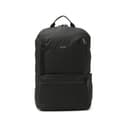
Roll it or carry it: the number that decides
A wheeled bag costs you empty weight and buys you carried weight. Those are different currencies and it is worth seeing the exchange rate.
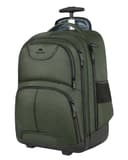
- MATEIN Roller Backpack: 4.9 lb empty, 36 L. Packed to 20 lb, almost all of it is on the floor.
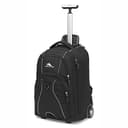
- High Sierra Freewheel: 5.5 lb empty, 34 L.
- Osprey Sojourn 45:7.5 lb empty, 45 L — the heaviest bag on this site, and the only wheeled one with a stowaway harness and a lifetime guarantee. We have not ranked it here because 7.5 lb of empty bag is a lot to justify, but it is the long-run wheeled choice and its review makes that case.
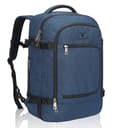
- Hynes Eagle 40L: 2.2 lb empty, 40 L. Packed to 20 lb, all of it is on your back.
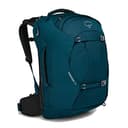
- Osprey Fairview 40: 3.2 lb empty, 40 L, with a belt designed to put most of that on your hips rather than your shoulders.
So the roller costs you about 2 to 3 lb of extra bag and removes roughly 20 lb from your body. If any part of your trip involves a long terminal, that is a good trade. If your trip involves stairs, cobblestones, train platforms or a European old town, wheels stop helping and the straps on these particular bags are why we chose rolling backpacks rather than rolling suitcases.
Fit: the bags that are never argued about
The standard US carry-on box is 22 x 14 x 9 in — the figure American, Delta, United, JetBlue and Alaska all print. Being inside it on all three published sides is worth more to an older traveler than to anyone else, because the alternative is a conversation at a gate and a bag that gets taken away at the jet bridge.
- High Sierra Freewheel: 19.5 x 13.5 x 8 in. Inside the box on all three sides, with 2.5 in of height margin, 0.5 in of width and 1 in of depth. It is the only wheeled bag we cover with real margin on every dimension, and on a rigid bag that matters more than on a soft one, because there is nothing to compress.
- MATEIN Roller Backpack: 19.6 x 13 x 9 in. Margin on height and width, exactly level on depth. Level is fine; over is not.
- Osprey Fairview 40: 21.3 x 13.8 x 9 in.Inside on all three sides — the only 40 L pack we cover that manages it — though with very little room to spare on width and depth.
- Hynes Eagle 40L: 20.1 x 13.4 x 9.8 in. Inside on height and width, 0.8 in over on depth. It is soft and it compresses, so a sensibly packed one clears.
- Pacsafe Metrosafe X 20L: 17.7 x 11.8 x 5.1 in.A personal item, not a carry-on — and comfortably inside every personal-item limit we track.
Wheels and handles count in every airline’s measurement, which is why so many rolling bags fail a sizer their listing claims they pass. Both rollers above are published inclusive of their hardware, and the rule itself is worth reading before you buy any wheeled bag.
What to look for, in the order it matters
- Decide whether the bag goes overhead. If lifting a packed bag to shoulder height is the problem, the answer is either a roller you lift empty-ish and push into the bin, or a personal item that goes under the seat in front of you. That single decision eliminates most of the market.
- Then read the empty weight. Every pound of bag is a pound of clothes you cannot bring on a 7 kg allowance. Our weight guide tables every published figure on this site.
- Then check the three dimensions against your airline. Published and dated, not guessed. Our size guide keeps every limit we track in one place.
- Then look for a load-bearing hip belt, if you are carrying. A padded belt on a structured back panel moves weight to your hips. Two webbing loops do not. Our hip-belt roundup separates them.
- Then size the harness to your torso, not your height. Two people the same height can need different packs. The torso-length guide is a five-minute measurement that decides more about comfort than any other number on this page.
- Last, think about the pack less and the load more. Fifteen pounds in a mediocre bag is more comfortable than twenty-five in an excellent one. Our one-bag packing list is built around exactly that.
On “backpacks for back problems”
This is a common search and it deserves a straight answer rather than a product pitch. No backpack is a treatment for anything, and nobody selling bags — us included — is qualified to tell you what your back can carry. What is true and checkable is mechanical: a load-bearing hip belt attached to a structured back panel transfers weight from your shoulders and spine onto your hips, which is why hiking packs have them and school bags do not. Wheels remove the load entirely while you are on flat ground. Both of those are design facts, and both are published features you can verify before you buy.
The rest is load. A 40-liter bag invites 40 liters of packing; a 34-liter wheeled bag invites less. If weight is your constraint, the smaller bag is usually the better buy for reasons that have nothing to do with the bag.
What about women’s-specific fit?
“Women’s” in pack marketing means a shorter back panel and narrower, contoured shoulder straps — a fit specification, not a capacity or a color. If the straps on a standard pack have always sat too wide or the back panel too tall, that is what the Osprey Fairview 40 solves, and it is the same bag as the Farpoint 40 on a different harness. It is not automatically the right call: a taller frame is often better served by the standard harness. Size to your torso. Our shorter-torso roundup and the women’s roundup both work from the measurement rather than the label.
What these specs cannot tell you
Two of the five picks here are budget Amazon-brand bags, and budget brands publish little: the MATEIN Roller publishes dimensions and weight but no warranty term, and neither roller publishes a wheel or bearing specification, which on a wheeled bag is the part most likely to fail first. We print “Not published” in those columns rather than filling them in. We also have not tested how any of these carries over an hour, because we do not own them — here is exactly what we do instead.