The arithmetic that defines this class
Start with the allowance rather than the bag. American, Delta, United, JetBlue and Alaska all publish the same cabin-bag box: 22 x 14 x 9 inches. Multiply it out and the box contains 2,772 cubic inches, which is 45.4 liters.
That single number explains the whole category. A 45L backpack is not “slightly larger than a carry-on.” It is a bag whose stated internal volume is the same as the total external volume of the space the airline gives you — and a bag has to put its own fabric, frame sheet, harness, handles, zip garages and side pockets somewhere outside that internal volume. The result is predictable and it holds for every pack here.
Here is each pick’s published exterior against that box, with the exterior multiplied out so you can see what the bag actually occupies in a bin.
Published exterior dimensions and calculated exterior volume of each 45L-class pack against the 22 x 14 x 9 in cabin allowance| Pack | Published exterior | Exterior volume | vs 22 x 14 x 9 in |
|---|
| The allowance itself | 22 x 14 x 9 in | 2,772 cu in (45.4 L) | — |
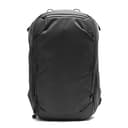
| Peak Design 45L (standard mode) | 22 x 13 x 9.5 in | 2,717 cu in (44.5 L) | Over by 0.5 in on depth; 1 in inside on width |
| Peak Design 45L (expanded) | 22 x 13 x 11 in | 3,146 cu in (51.6 L) | Over by 2 in on depth |
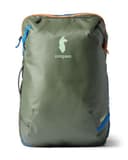
| Cotopaxi Allpa 42L | 22 x 14 x 11 in | 3,388 cu in (55.5 L) | Over by 2 in on depth; exactly level on height and width |
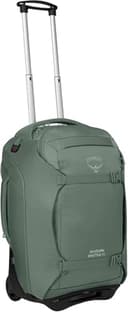
| Osprey Sojourn 45 (packed figure) | 22 x 14 x 9 in | 2,772 cu in (45.4 L) | Exactly the box, no margin on any side |
| Osprey Sojourn 45 (overall figure) | 23.2 x 16.9 x 13 in | 5,096 cu in (83.5 L) | Over on all three by 1.2 / 2.9 / 4 in |
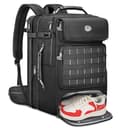
| MATEIN 52L (closed) | 21 x 13 x 9 in | 2,457 cu in (40.3 L) | Inside on height and width, level on depth |
| MATEIN 52L (expanded) | 21 x 13 x 10.5 in | 2,866 cu in (47.0 L) | Over by 1.5 in on depth |
Read down the right-hand column and the finding is unanimous: not one 45L-class pack we rank publishes an exterior that is inside the standard box on all three dimensions, and every single failure is on the same axis — depth. That is not a coincidence either. Height and width are cheap for a designer to respect because a bag can be long and wide without feeling big; depth is where liters are actually won, so depth is where a 45L pack spends its budget.
It also means the MATEIN is the interesting entry in the table. Closed, it is the only pack here with real margin — an inch on height, an inch on width, level on depth — and its closed exterior of 2,457 cubic inches is comfortably smaller than the allowance. It earns that by not actually being a 45L bag until you unzip it. That is the trade this whole class offers, stated plainly.
What 45 liters costs you on a scale
The US majors publish a dimension limit and no cabin weight limit at all. Outside the US, weight is usually the binding constraint instead: Emirates and Qantas publish 7 kg (15.4 lb) for Economy cabin baggage and Lufthansa publishes 8 kg (17.6 lb). At those limits the empty bag is a real line item.
- Cotopaxi Allpa 42L — 3.13 lb. About 20% of a 7 kg allowance, 18% of 8 kg. The lightest pack in this class, and by a wider margin than the price difference suggests.
- MATEIN 52L — 3.42 lb. About 22% of 7 kg, 19% of 8 kg. The same published empty weight as the Nomatic Travel Bag 40L, for twelve more liters when open.
- Peak Design 45L — 4.5 lb. About 29% of 7 kg, 26% of 8 kg. You are paying 1.4 lb for the aluminum hardware, the expansion structure and the weatherproof shell.
- Osprey Sojourn 45 — 7.5 lb. About 49% of a 7 kg allowance before anything goes in it, and 43% of 8 kg. Wheels, a chassis and a stowable harness weigh what they weigh.
Turn those into capacity per pound of bag and the ranking inverts the price list completely: the MATEIN returns about 15.2 L per pound expanded, the Allpa 13.4, the Peak Design 10.0, and the Sojourn 6.0. For calibration against the class below, the Osprey Farpoint 40 returns 12.9 and the Hynes Eagle 40L 18.2. A 45L pack is not an efficient way to buy volume — it is a way to buy volume you can carry on your back in one piece. The carry-on weight limits guide has the carrier-by-carrier figures.
The criteria we used, in order
1. Does the maker publish an exterior at all?
This is the gate, and in this class it eliminates more bags than any other test. A 45L pack whose maker will not print a dimension figure is a bag you cannot evaluate against any airline’s published rule, and at this capacity that is the only question that matters. We left the Osprey Daylite Duffel 45 off this page for a different reason — it currently returns no live price through our price layer, so there is nothing reachable to buy — but it also publishes neither an exterior nor an empty weight.
2. Does it have a second, smaller mode?
In a class where nothing fits, the ability to become a bag that does is worth more than any feature. Two of the four have it: the Peak Design compresses to a stated 35L for carry-on use and expands to 45L for the leg home, and the MATEIN zips down from 52L to 40L. The Allpa and the Sojourn are one size, all the time.
3. Is the weight proportionate to the volume?
Expressed as capacity per pound, since that is the comparison a buyer can actually act on. We print it for every pack rather than ranking on raw weight, because a heavy 45L bag and a heavy 20L bag are not the same failure.
4. Is there a warranty, and does it have holes?
Three of the four publish a term and we quote them rather than summarizing: Osprey’s All Mighty Guarantee covers any Osprey product from any era, Cotopaxi’s Guaranteed for Good runs for the lifetime of the product, and Peak Design’s lifetime warranty covers failures that make the product non-functional but excludes items bought on secondhand marketplaces or auction sites— a real exclusion on a bag this resellable. MATEIN publishes no term at all.
Who should buy which
Buy the Peak Design 45L if you want one bag that is a compliant carry-on on the way out and a 45L bag on the way home, and you will use the compression. It publishes the most, it is built the best, and the warranty is real. It is also the most expensive thing on this page by a wide margin and it has no published hip belt, so its 4.5 lb rides on your shoulders. Our Peak Design Travel Backpack 45L review goes through every mode, and Peak Design 45L vs Osprey Farpoint 40 is the comparison most people arriving here actually need.
Buy the Cotopaxi Allpa 42L if organization and weight matter more than compliance. It is the lightest bag in the class, the internal mesh layout is the best here for finding things without unpacking, and the warranty has no channel restriction. You are accepting 11 inches of depth and zero margin on height or width, which is a gate-check risk on any carrier with a hard sizer. The Cotopaxi Allpa 42L reviewruns it against five carriers’ published limits.
Buy the Osprey Sojourn 45if your honest answer is that you do not want to carry 45 liters. It is the only pack here with wheels and the only one with a genuine stowable load-bearing harness, and Osprey publishes a packed figure of exactly 22 x 14 x 9 in — which is both the best and the most delicate result on this page, because exactly level is not inside and a rigid wheeled bag cannot be squeezed. Its own overall figure of 23.2 x 16.9 x 13 in is the one a gate agent measuring wheels and handles would get. We compare it to the carry version in Farpoint 40 vs Sojourn 45.
Buy the MATEIN 52L if the trips you take are road trips, checked-bag flights, or five-to-seven-day itineraries where you fly the bag zipped down. It is the cheapest way into this class by an order of magnitude, it arrives with three packing cubes and a toiletry bag, and closed it has more sizer margin than anything else here. What you give up is any published fabric, any published warranty and any premium in the hardware.
The case against the whole class
We rank these bags because people buy them, and the four above are the ones worth buying. But the arithmetic at the top of this page is also an argument, and it is worth stating in one place: 45 liters is the volume of the allowance, so a 45L bag can only fit the allowance by being made of nothing.
In practice that means one of three things happens at the gate. The bag is soft and half-empty and nobody measures it, which is the common case and is luck rather than compliance. The bag is measured and gate-checked, which costs you time and sometimes money. Or you planned for the hold from the start, in which case 45 liters is a perfectly sensible size and none of this matters.
If you want the first outcome to be reliable rather than lucky, the answer is a smaller bag, not a better 45L bag. A 40L pack with published dimensions inside the box exists; a 45L one, in our coverage, does not. We make that case properly in what size travel backpack do you need and is a 40L backpack a carry-on, and the bags that genuinely measure up are on the backpacks that actually fit 22 x 14 x 9.