“TSA-approved” is not a thing. Here is what is.
The TSA is a screening agency. It decides what may pass through a checkpoint and it runs no certification program for luggage, so no backpack carries its approval and no manufacturer can be granted it. What the agency does publish is a prohibited-items list and the rules on liquids and lithium batteries, and its own carry-on page refers travelers to their airline for dimensions. That single sentence is the whole answer to the query, and it is why a pack sold as “TSA approved” at $30 is making exactly the same claim as one at $300: none.
Three phrases get used interchangeably on listings and they mean different things:
- “TSA approved”— marketing. There is no such approval.
- “Flight approved” / “airline approved” — also marketing, and it is in the actual model name of one pack on this page. It means the seller believes the bag is about carry-on sized. No airline has signed anything.
- “TSA-friendly” or “checkpoint-friendly” — the one with real content. It describes a laptop compartment that opens flat and holds nothing but the computer, so the laptop can be screened inside the bag rather than taken out.
Question one: does it clear the airline’s published box?
The standard US box is 22 x 14 x 9 inches, which multiplies out to 2,772 cubic inchesof total space — bag, harness, hardware and air included. Published exteriors of the five packs here against it:
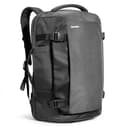
- tomtoc Navigator-T66 40L — 20.5 x 13 x 9 in (2,398 cu in). An inch and a half inside on height, an inch inside on width, exactly level on depth. Nothing over, with margin on two axes, at a full 40 liters. That combination is rare and it is why this pack leads the page.
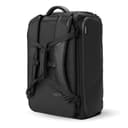
- Nomatic Travel Bag 40L — 21 x 14 x 9 in (2,646 cu in).An inch inside on height, exactly level on width and depth. Nothing over — and no reserve either, which matters because a structured bag cannot squeeze.
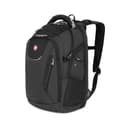
- SwissGear Travel Tech Elite — 18 x 11.5 x 7 in (1,449 cu in). Inside on all three axes with inches to spare in every direction. At 31.4 liters it is the smallest pack here, and the only one we would also expect to pass as a personal item on a US major.
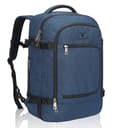
- Hynes Eagle 40L — 20.1 x 13.4 x 9.8 in (2,640 cu in). Nearly two inches inside on height, 0.6 in inside on width, 0.8 in over on depth. Soft-sided, so underpacked it measures less than its spec sheet.
- BAGSMART 35L — 18.11 x 12.22 x 9.44 in (2,089 cu in). Almost four inches inside on height and nearly two on width, 0.44 in over on depth. The cheapest published exterior we track in this class.
Two caveats we will not skip. A published depth is the bag’s fulldepth, so a soft pack carried under capacity measures less — which is why underpacking is the only reliable way to clear a sizer and no purchase substitutes for it. And a published figure is the maker’s, not a measurement we took; the carry-on verdicts in the table are our own read of those numbers against the airlines’ own, stated as a read. Carrier-by-carrier limits are in our carry-on size guide, and the packs built specifically to the standard US box are on carry-on backpacks that fit 22 x 14 x 9.
Question two: does it move through the checkpoint?
Only the SwissGear Travel Tech Elite is built for this, and it is worth being precise about what the feature does. Its ScanSmart section unzips into its own flat layer with the laptop alone inside, nothing above or below it, which is the condition the X-ray operator needs. The practical effect is that you put one item in a bin instead of three and you do not stand at the far end of the belt repacking a computer while the line builds behind you.
What it does not do is guarantee anything. Officers can and do ask for electronics out regardless, lanes with newer CT scanners often do not require it from anybody, and PreCheck lanes change the question entirely. So treat a lay-flat sleeve as a convenience that usually works rather than a rule you can insist on. The other four packs here state a padded sleeve from 15.6 to 17.3 inches, none of it described as checkpoint-friendly, and the laptop should come out.
The rest of checkpoint speed is packing, not hardware: liquids in one quart-sized bag at the top of the pack where you can reach it, power banks and spare lithium cells in the cabin bag rather than a checked one, and nothing in the main compartment that will need to be excavated. We go through that in the TSA liquids rule and power banks on planes.
Weight, in liters per empty pound
From each maker’s published figures: Hynes Eagle 40L 18.2, tomtoc Navigator-T66 15.1, Nomatic Travel Bag 40L 11.7, SwissGear Travel Tech Elite 10.5. The BAGSMART publishes no weight, which we print as “Not published.” Against a 7 kg cabin allowance of the kind Emirates and Qantas publish, those packs spend 14, 17, 22 and 19 percent of the whole allowance on themselves before a shirt goes in. Caps, by carrier, are in carry-on weight limits by airline.
Which one, by the way you fly
You fly US majors and want the most bag that still clears
tomtoc Navigator-T66 40L. It is the only 40-liter pack we cover with nothing over the standard box and margin on two axes, it states a 17.3-inch laptop compartment, and it publishes its fabric (recycled 1680D PET) and its warranty term, which most of this price class does not. The term is short — one year, two with registration — and that is the honest trade against the lifetime brands.
You want one bag for a decade and the checkpoint is not the problem
Nomatic Travel Bag 40L. Level with the box on two axes, a 16-inch sleeve in a dedicated padded compartment, converts to a duffel, lifetime warranty. It is also the heaviest fixed-volume pack here and has no squeeze in reserve, so pack it to the published depth and no further.
Security lines are the part of flying you hate
SwissGear Travel Tech Elite. The ScanSmart lay-flat laptop section is the real version of what this whole search is reaching for, the published exterior is inside the box on every axis, and it is the one pack here that doubles as a personal item on a US major. You are buying 31.4 liters, so it is a work-trip bag rather than a two-week bag.
You want to carry as little empty weight as possible
Hynes Eagle 40L. Forty liters, a hip belt and compression straps at 2.2 lb, the most weight-efficient pack on this site at any price. Its model name contains the words “Flight-Approved,” which is precisely the label this page is about: it publishes no warranty and names no fabric, so treat it as a few-years bag. It is also the value pick on travel backpacks under $100.
You want the cheapest bag that still proves its size
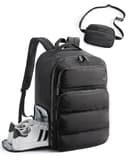
BAGSMART 35L. It is the budget pick for one specific reason: at this price almost nothing publishes an external dimension, and this does — 18.11 x 12.22 x 9.44 in, inside on height and width and 0.44 in over on depth. It adds a shoe compartment and a 17.3-inch laptop sleeve. No weight, no fabric and no warranty term are published, which is the trade at the price, stated plainly.
What we are not claiming
We own none of these packs and have not taken them through a checkpoint. Every dimension, weight, sleeve size and warranty term above is the manufacturer’s own published figure, read from its own page or listing on a dated visit and cited below. The carry-on verdicts are our read of those published numbers against the airlines’ own published limits, stated as a read rather than as a manufacturer claim. No ratings, test results or awards appear on this page, because we have run none. We also make no claim about how any officer at any checkpoint will behave on any given day.