The box arithmetic, which inverts the price list
Multiply the 22 x 14 x 9 inch allowance that the US majors publish and you get 2,772 cubic inches — about 45 liters of total space, fabric, frame, harness and handles included. Any 40L bag is therefore claiming most of the allowance as cargo, and the only way to know whether it clears a sizer is to read the exterior the maker publishes. Here is what the five packs above publish, run against that box:
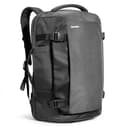
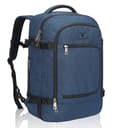
- tomtoc Navigator-T66 40L — 20.5 x 13 x 9 in. Inside on height by 1.5 in, inside on width by 1 in, exactly level on depth. The only 40L pack on this page inside the box on all three axes, and it costs about 40 percent of the top pick.
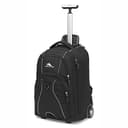
- High Sierra Freewheel — 19.5 x 13.5 x 8 in. Margin on all three sides, which matters more on a wheeled bag because a rigid shell cannot be squashed into a sizer the way a soft pack can.
- Hynes Eagle 40L — 20.1 x 13.4 x 9.8 in. Inside on height and width, over on depth by 0.8 in. One axis out, and the soft one.
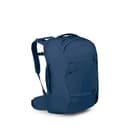
- Osprey Farpoint 40 — 21 x 15 x 10 in. Inside on height, but over a 14 in width limit by an inch and over a 9 in depth limit by an inch. Two axes out, on the most expensive pack here.
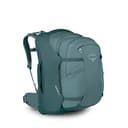
- Osprey Fairview 55 — 24.6 x 13 x 11.8 in. Over on height and depth, and not pretending otherwise: it is a 40L pack with a 15L daypack zipped to it, sized for a trip you check or gate-check.
Published dimensions are not destiny — a soft 40L pack packed to 30L compresses, and most gate agents never reach for a sizer. But the numbers are the only evidence that exists before you own the bag, and they say plainly that at this price you are not buying fit. If clearing a strict European sizer is the whole requirement, read the packs that fit 22 x 14 x 9 and the carry-on size guide before you spend anything.
What the second hundred dollars actually buys
A belt attached to something
Every pack on this page has a hip belt. They are not the same object. A load-bearing belt is shaped, padded and anchored to a structured back panel, so the weight travels into your pelvis; a budget belt is webbing sewn to the bag body, which stabilizes the load without carrying it. No maker publishes a figure for the difference, which is why we state it as a distinction rather than a number. It is the single thing you feel on a twenty-minute walk with a full bag, and it is most of what separates the Farpoint from the Hynes Eagle. The mechanics are in why your backpack hurts your shoulders.
Recourse when it breaks
This is the clearest difference in the whole band, and it is the one you can check before buying. Both Ospreys carry the All Mighty Guarantee, under which Osprey repairs or replaces the pack. The High Sierra Freewheel carries a limited lifetime warranty. The tomtoc states one year, two with registration. The Hynes Eagle publishes no warranty at all— the table says “Not published” because that is what the listing says, and the absence is the information. Across enough trips, a pack that gets repaired is genuinely the cheaper purchase; across three trips, it isn’t.
Nothing else, reliably
Capacity per pound is the figure that embarrasses the price list. The Hynes Eagle carries 18.2 liters for every empty pound, the tomtoc 15.1, the Fairview 55 14.5, the Farpoint 40 12.9, the Freewheel 6.2. The two cheapest packs are the two most efficient, and the gap matters on the carriers that weigh your cabin bag: against the 7 kg (15.4 lb) allowance Emirates and Qantas publish, these bags spend 14, 17, 25, 20 and 36 percent of it empty. Full figures by class are in carry-on weight limits by airline.
How we picked, and what we left out
We started from every pack in our registry carrying a live price under $200, then kept the ones that answer a genuinely different question: one do-everything carry-on, one value pick, one longer-trip convertible, one wheeled bag and one budget bag. Packs priced into this band but duplicating another pick’s job were left off rather than padded in.
Two notable exclusions. The Fairview 40 — the shorter-torso sibling of our top pick, and the only 40L pack we cover that publishes an exterior inside the box on all three sides — returned no buyable offer on the most recent price refresh, so it is not ranked here; if it is back in stock when you read this, it is the better buy than the Farpoint for a shorter torso. And the Eagle Creek Cargo Hauler 40L sits in this band but is a duffel you can wear, not a pack — it belongs on the duffel page, where it is the top pick.
Who should spend more, and who should spend less
Spend more if you have decided the bag is a ten-year purchase: above $200 the premium field adds lifetime warranties with teeth, weatherproof shells and genuine organization, and the case for each step is laid out in the premium roundup and in how much you should spend on a travel backpack. Spend less if you travel two or three times a year: the honest reading of the specs above is that under $50 buys you the same liters at a lower weight, and the trade is longevity you may never test. That field is travel backpacks under $50. The band immediately below this one is the odd one out, and worth knowing about before you shop it: best travel backpacks under $150 exists because no full-size one-bag carry-on in our registry is priced between $100 and $150 — everything in that window is a specialist.
And if you already know you want the Osprey, the real question is which Osprey. The brand’s own ladder — Farpoint 40, Fairview 40, the 55L convertibles and the wheeled Sojourn — is compared side by side on best Osprey travel backpacks, and the packs people buy instead of a Farpoint are on Osprey Farpoint 40 alternatives.
The $20 upgrade that beats changing bags
If you are deciding between two packs twenty dollars apart, buy the cheaper one and spend the difference on packing cubes. Cubes turn one cavity into a sorted system, and they make a soft pack hold a squarer shape against a sizer — which, given the dimensions above, is the problem most of these bags actually have.