Passage & Pier

Best Travel Backpacks with a USB Charging Port

No backpack charges anything. The port on the strap is a short extension cable to a power bank you supply — which is either exactly what you want, or a reason to skip the feature entirely.

By Stephen V.Last updated How we choose

Start with the thing the listings never say plainly: a backpack with a USB charging port does not contain a battery. The port is one end of a short cable; the other end is inside the bag, waiting for you to plug in a power bank you bought separately. Nothing is charged by the bag. What the feature genuinely buys you is that your phone can charge while the bank stays zipped inside, so you are not walking around with a charger dangling from a pocket.

That is a modest but real convenience, and once you understand it the buying decision gets simple: the port is a nice-to-have on a bag you were buying anyway, never a reason to choose a worse bag. All three picks below are budget personal-item packs, because that is genuinely where this feature lives — the premium travel-pack brands almost universally leave it off, and the section below explains why they are probably right.

How this is funded:we earn a commission if you buy through our links, at no extra cost to you. It never changes which bag we recommend, and we’ll tell you when we’d skip one. Full disclosure.

Quick picks

Ranked on capacity, carry-on fit and who each bag actually suits. Select a row to jump to the full write-up. We have not flown every one of these — here is exactly what we do instead.

#ProductBest forPrice
1
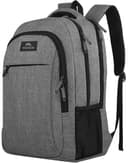
MATEIN Travel Laptop Backpack (Anti-Theft)

MATEIN Travel Laptop Backpack (Anti-Theft)

One of Amazon's best-selling laptop backpacks for a reason: it's a cheap, sensible personal-item bag with a hidden back pocket, a USB pass-through and a luggage sleeve. Not a travel 'system,' just a reliable day-and-commute bag that flies well as your second item.

Best overall
$18.69 · View on Amazon

$33.9945% off

Price as of September 4, 2026. #ad How we’re funded

2
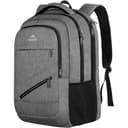
MATEIN 17" TSA-Friendly Carry-On Backpack

MATEIN 17" TSA-Friendly Carry-On Backpack

A larger MATEIN with a lay-flat TSA laptop section — the pick if you fly with a big laptop and want the security lane to go quickly. Roomy enough for a light overnight as a personal item, though it's a work bag at heart.

Best for a large laptop
$23.99 · View on Amazon

$25.998% off

Price as of September 4, 2026. #ad How we’re funded

3
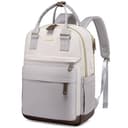
LOVEVOOK Anti-Theft Travel Laptop Backpack (Women's)

LOVEVOOK Anti-Theft Travel Laptop Backpack (Women's)

A women's-styled work-and-travel backpack with a concealed back pocket, USB port and a 15.6" laptop sleeve — the practical, good-looking personal item for commuting that also flies well. Anti-theft here is a hidden pocket, not a security system.

Best for work and travel
$28.88 · View on Amazon

$40.9930% off

Price as of September 4, 2026. #ad How we’re funded

The picks in full

#1Best overall

MATEIN Travel Laptop Backpack (Anti-Theft)

One of Amazon's best-selling laptop backpacks for a reason: it's a cheap, sensible personal-item bag with a hidden back pocket, a USB pass-through and a luggage sleeve. Not a travel 'system,' just a reliable day-and-commute bag that flies well as your second item.

Strengths

  • Hidden anti-theft back pocket and lockable main zippers
  • USB pass-through and a padded 15.6" laptop sleeve
  • Luggage strap sleeve to stack it on a roller

Trade-offs

  • A commuter bag, not a one-bag travel pack
  • Budget materials — functional, not premium
CapacityNot published
Weight (empty)Not published
External dimensionsNot published
Carry-on fit (our read)Personal-item sized
Laptop sleeve15.6 in
MaterialNot published
WarrantyNot published

Fit note. 'Anti-theft' here means a concealed back pocket and lockable zippers — real deterrents for a day bag, not a slash-proof security pack. As a cheap personal item it's hard to beat.

Specs read from the product listing, on July 21, 2026. “Not published” means the maker does not state that figure.

#2Best for a large laptop

MATEIN 17" TSA-Friendly Carry-On Backpack

A larger MATEIN with a lay-flat TSA laptop section — the pick if you fly with a big laptop and want the security lane to go quickly. Roomy enough for a light overnight as a personal item, though it's a work bag at heart.

Strengths

  • TSA lay-flat laptop compartment speeds up security
  • Fits up to a 17" laptop with room for a day's kit
  • USB pass-through and luggage sleeve

Trade-offs

  • Work-bag ergonomics, not travel-pack comfort
  • Budget build
CapacityNot published
Weight (empty)Not published
External dimensionsNot published
Carry-on fit (our read)Personal-item sized
Laptop sleeve17 in
MaterialNot published
WarrantyNot published

Fit note. The lay-flat laptop panel is the reason to pick this over the smaller MATEIN — it means you don't unpack the laptop at security. Still a work bag, not a one-bag travel pack.

Specs read from the product listing, on July 21, 2026. “Not published” means the maker does not state that figure.

#3Best for work and travel

LOVEVOOK Anti-Theft Travel Laptop Backpack (Women's)

A women's-styled work-and-travel backpack with a concealed back pocket, USB port and a 15.6" laptop sleeve — the practical, good-looking personal item for commuting that also flies well. Anti-theft here is a hidden pocket, not a security system.

Strengths

  • Concealed back pocket and a professional, non-techy look
  • Fits a 15.6" laptop with organized front pockets
  • USB pass-through and luggage sleeve

Trade-offs

  • 'Anti-theft' is a hidden pocket, not slash-proof construction
  • A day/commute bag, not a one-bag travel pack
CapacityNot published
Weight (empty)Not published
External dimensionsNot published
Carry-on fit (our read)Personal-item sized
Laptop sleeve15.6 in
MaterialNot published
WarrantyNot published

Fit note. For most travelers the concealed back pocket is deterrent enough. If you're heading somewhere genuinely pickpocket-heavy, step up to a slash-resistant Pacsafe instead.

Specs read from the product listing, on July 21, 2026. “Not published” means the maker does not state that figure.

What the port actually is

Inside the bag there is a female USB socket on a short lead. Outside, usually on the shoulder strap or the side panel, there is a male port. You put your power bank in the internal pocket, plug it into the internal socket, and then charge your phone from the external port with your own cable.

Three practical consequences follow, and every one of them is something buyers get wrong:

  • You still need to buy a power bank.The bag supplies no power. A 10,000 mAh bank is the sweet spot for travel — roughly 37 Wh, comfortably under every airline threshold.
  • You still need your own cable on the outside. The pass-through carries current from the bank to the port; it does not terminate in a connector for your phone.
  • It is USB-A, and it is slow. These are almost always legacy USB-A pass-throughs with no fast-charge negotiation. Expect trickle charging, not the speed you get plugged into a wall.

The battery rules that actually govern this

Because the power is a loose lithium battery, the rules that matter are the ones about spare batteries, and they are strict and non-negotiable: power banks fly in the cabin and are prohibited in checked baggage. The FAA allows batteries up to 100 Wh with no approval, 101–160 Wh with airline approval and a limit of two spares, and forbids anything above 160 Wh outright.

The conversion you need is one line: watt-hours = (mAh ÷ 1,000) × 3.7. So a 10,000 mAh bank is about 37 Wh and a 20,000 mAh bank about 74 Wh — both fine. Anything above roughly 27,000 mAh is over the 100 Wh line and becomes a conversation at a gate. The full version, including what to do if your bag gets gate-checked with a bank inside it, is in power banks & lithium batteries on planes.

One more consequence specific to these bags: several airlines have recently added their own rules about using or charging power banks in flight. Because those are carrier-specific and changing, check your airline’s own page rather than assuming the strap port is fair game at 35,000 feet.

Why the good travel-pack brands skip it

Osprey, Cotopaxi, Eagle Creek and Pacsafe do not put USB pass-throughs on their travel packs. That is not an oversight, and it is worth understanding before you weight this feature heavily.

It is a hole in the bag. Any external port is a place water gets in and a place a panel has to be reinforced. On a pack sold on weather resistance that is a real cost for a small convenience.

It is the first thing to break.A soldered socket on a flexible shoulder strap is a hinge point with electronics in it. When it fails — and it is the most commonly reported failure on bags that have it — you have a dead port sewn into a bag you otherwise like.

A cable does the same job. Run your own short cable from the bank in an internal pocket out through a zip gap. It costs nothing, cannot break the bag, works with fast charging, and works on every bag you will ever own.

That last point is the honest verdict on this whole category: the feature is fine, and the workaround is free. Buy one of these bags because it is a good cheap personal item — which the MATEIN genuinely is — and treat the port as a bonus.

What to look for if you do want it

  • Port placement on the strap or the upper side panel. A port at the bottom of the bag means the cable runs down your body and catches on things.
  • A dedicated internal battery pocketwith an elastic retainer, so the bank is not loose against a laptop. Loose spare batteries against metal is precisely the short-circuit scenario the FAA’s terminal-protection rule exists to prevent.
  • A cover or flap over the external port. An uncovered socket collects lint, rain and grit, and grit is what kills it.
  • Everything you would want in the bag anyway— a padded laptop sleeve, a luggage trolley sleeve, and dimensions that let it fly as a personal item. Check those against your airline’s numbers before the port enters the decision at all.

A note on “anti-theft” on these bags

All three picks are marketed as anti-theft, and on this class of bag that word means a concealed pocket against your back and nothing more. It is genuinely useful against a casual hand in a crowd; it is not slash-resistant mesh or locking zippers. We rank the tiers honestly in our anti-theft travel backpacks roundup, and the pattern is the same as the USB port: a real small feature, oversold.
Frequently asked questions

Do backpacks with USB ports come with a battery?

No. The port is a pass-through — a short cable with a socket inside the bag and a port outside it. You supply the power bank, and you supply the cable that runs from the external port to your phone. Any listing that implies the bag charges your devices on its own is describing something that doesn't exist.

Can you take a backpack with a USB port on a plane?

Yes. The bag itself contains no battery, so it's an ordinary backpack. The power bank you put in it is the regulated item: it must travel in the cabin, never in checked baggage, and must be under 100 Wh (about 27,000 mAh) to need no approval. If your bag gets gate-checked, take the power bank out first.

Are USB charging backpacks worth it?

As a bonus on a bag you'd buy anyway, sure. As a reason to choose one bag over a better one, no — a short cable run from a power bank in an internal pocket does exactly the same job, costs nothing, supports fast charging and can't break the bag. The port is also the most commonly reported failure point on bags that have one.

Why don't Osprey or Cotopaxi make backpacks with USB ports?

Because an external port is a hole in a weather-resistant shell, a soldered component on a flex point, and a warranty liability — for a convenience a cable already provides. Brands that sell on durability and guarantees have consistently decided the trade isn't worth it, and on the evidence they're probably right.

How fast do backpack USB ports charge?

Slowly. These are legacy USB-A pass-throughs with no fast-charge protocol negotiation, so you get a trickle rather than the rate you'd see from a wall charger or a direct USB-C connection to the bank. Treat it as topping up while you walk, not as charging a flat phone before a flight.

Sources

Keep reading