The box arithmetic, which decides whether you are checking a bag
Multiply the 22 x 14 x 9 inch allowance the US majors publish and you get 2,772 cubic inches — about 45.4 liters of total space, fabric, frame and handles included, not just interior volume. That one figure is why a 50-liter bag cannot be a carry-on in any ordinary sense, and why a 40-liter bag sits right at the ceiling. Against that box:
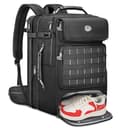
- MATEIN 52L Expandable — 21 x 13 x 9 in closed (2,457 cu in), 10.5 in deep expanded. Inside the box on all three axes closed, with real margin on height and width, which it earns by not being a 52-liter bag until you unzip it. Expanded it is 1.5 in over on depth and no longer carry-on sized. This is the only bag on the page that lets you choose.
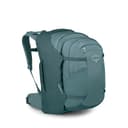
- Osprey Fairview 40 — 21.3 x 13.8 x 9 in (2,645 cu in). Inside on height, inside on width, exactly level on depth. The only 40L pack we cover that is inside the standard box on all three sides— and it is the women’s-fit one, which is a happy accident of design rather than a rule.
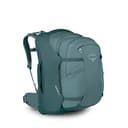
- Osprey Fairview 55 — 24.6 x 13 x 11.8 in. Over on height by 2.6 in and depth by 2.8 in, inside on width by an inch. Not pretending otherwise: this is a bag for the hold or the gate.
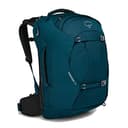
- Osprey Farpoint 55 — 25 x 13 x 12 in. Over on height by 3 in and depth by 3 in. Same conclusion, a touch larger.
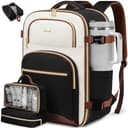
- LOVEVOOK 40L — nothing published.No exterior, no empty weight, no warranty term; the table prints “Not published” in all three columns because that is what the listing says. It states 40 liters, a 17.3-inch laptop sleeve and three packing cubes included.
No amount of compression fixes three inches of height. If staying out of the hold is non-negotiable, the choice is the Fairview 40, the MATEIN closed, or the LOVEVOOK on trust — and your carrier’s own number is in the carry-on size guide.
The same gap defines the budget end of this category, where it is worse: under $100 not one pack publishes a torso length or even an empty weight. What you can check instead, and which bags are actually shorter, is on best travel backpacks for women under $100.
The missing harness, stated plainly
Of the five bags above, two are sold on a women’s-fit harness: the Fairview 55 and the Fairview 40. The LOVEVOOK is marketed to women but publishes no harness or torso figure of any kind, which means its “women’s” label cannot be checked. The MATEIN 52L and the Farpoint 55 are standard-fit bags, and we have ranked them anyway because the alternative — a three-bag page — would have been less useful than an honest five-bag one.
This is a market gap rather than a research gap. Above 40 liters the brands that publish a fit spec mostly offer one harness, and the budget brands that dominate the 50L+ band publish no harness figures at all. The practical consequence is specific and worth planning around: on a back panel that is too long for your torso, the hip belt lands above your hip bones on soft tissue, where it cannot transfer load however well it is padded. That is the usual reason a large pack hurts, and it is a fit problem rather than a bag problem — the mechanism is in why your backpack hurts your shoulders, and the torso bands are mapped to packs on women’s carry-on backpacks by torso size.
Weight, where the women’s-fit pack wins outright
Capacity per empty pound, from each maker’s published figures: MATEIN 52L 15.2, Fairview 55 14.5, Farpoint 55 14.1, Fairview 40 12.5. Against the 7 kg (15.4 lb) cabin allowance Emirates and Qantas publish, these bags spend 22, 25, 25 and 21 percent of your allowance empty.
Two things worth pulling out of those numbers. First, the women’s-fit Fairview 55 is lighter than the standard-fit Farpoint 55— 3.8 lb against 3.9 lb — for identical capacity, so the better-fitting bag is also the more efficient one and fit costs you nothing here. Second, the big packs are more weight-efficient than the 40L ones, because a harness and frame cost roughly the same whether they sit on a 40-liter body or a 55-liter one. That is the real argument for going large if you have already accepted the checked bag: more liters per pound carried. Airline figures are in carry-on weight limits by airline and how much a travel backpack weighs.
The 55L packs are two bags, and that changes the math
Both Ospreys here are a 40L main pack with a 15L zip-on daypack, not a single 55-liter cavity. That is the strongest reason to pick one over a plain 50L bag: the daypack detaches, so you get a main bag for the hold and a day bag for the trip, in one purchase and under one warranty. Detached, the 40L half is the same size as a standard carry-on, which also means a 55L Osprey can sometimes be split rather than checked.
It also means you do not need a separate second bag, which is the usual hidden cost of going large. If you are buying a plain large pack instead, budget for a packable day pack— a good one weighs under a quarter of a pound and takes about a liter out of your main bag.
Warranty, and what each tier actually promises
All three Ospreys carry the All Mighty Guarantee, under which Osprey repairs or replaces the pack. The MATEIN 52L and the LOVEVOOK 40L publish no warranty term at all— the table prints that rather than assuming one. On a large bag that gets checked, loaded by machine and dragged across baggage halls, that gap is more consequential than it is on a carry-on you keep with you: the failure modes of a checked bag are exactly the ones a warranty covers.
The honest counterweight, as everywhere on this site: across three trips the cheap bag is the correct purchase and the warranty is theoretical. Across forty it is the whole argument. Where your own trips fall is worked through in how much you should spend on a travel backpack.
One pack with no live price
The Fairview 40 is the best-fitting bag on this page and it returned no buyable offeron the most recent price refresh — its third such result in four refreshes. That is why it is ranked fourth rather than first: we will not put a top slot behind a bag with no price to show. Its card falls back to a direct check-price link rather than a number, and if it is in stock when you read this, it is the pack to buy for a shorter torso that needs to stay carry-on.
For the rest of the women’s field at carry-on size, including the packs that fly as a personal item, see best carry-on backpacks for women and best personal-item backpacks for women.