The arithmetic that makes this the easy class
Multiply the 22 x 14 x 9 inch allowance the US majors publish and you get 2,772 cubic inches, which is 45.4 litersof total space — the bag’s own fabric, frame, harness and handles included, not just its interior. That single figure explains the whole capacity ladder. At 45L a pack is claiming the entire allowance as cargo and must build itself outside the box; at 40L it has about 5 liters of slack; at 30L it has about 15. Here is what that slack buys, in each maker’s own published numbers:
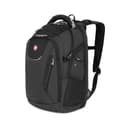
- SwissGear Travel Tech Elite — 31.4L, 18 x 11.5 x 7 in (1,449 cu in). Four inches inside on height, 2.5 in inside on width, 2 in inside on depth. Margin on every axis, which is why it is the pick for anyone who has ever been asked to put a bag in a sizer.
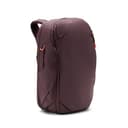
- Peak Design Travel Backpack 30L — 30L, 20.9 x 13 x 7 in, 7.9 in deep expanded. Inside the box on all three axes in bothmodes — the only expandable pack we cover that manages that. 3.17 lb for 27–33 liters.
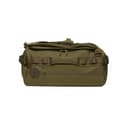
- Baboon to the Moon Go-Bag — 32L, 18.5 x 12 x 9.5 in (2,109 cu in). Well inside on height and width, 0.5 in over on depth. Baboon publishes no empty weight.
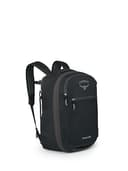
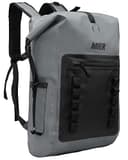
- MIER Roll Top 30L and Osprey Daylite Expandable 26+6 — no published exterior.Neither maker states dimensions or an empty weight for these, so the table prints “Not published” in both columns. In the MIER’s case the roll-top closure is its own answer: a half-empty roll-top rolls down smaller, so the usable height is whatever you roll it to.
Compare that to the 45L class, where not one pack we rank publishes an exterior inside the box on all three sides and every failure is on depth. The 30L class is the inverse: the fit question mostly answers itself, and you get to choose on the things that actually differ.
What actually differs at 30 liters
Whether the laptop section lies flat
A 30L bag is most often a work bag, so the laptop compartment matters more here than in any other class. SwissGear states a 16-inch sleeve plus an 11 x 8.5 in tablet pocket in a section designed to lie flat for security; Peak Design states a 16-inch sleeve (published max 16 x 11 x 1 in) plus a 10-inch tablet sleeve in a rear-loading clamshell. The Baboon, the MIER and the Daylite state no laptop size at all — two of them have no padded sleeve to state. There is no such thing as a TSA-approved backpack, and what “TSA-friendly” actually means is in what makes a backpack TSA-friendly.
Whether it is waterproof or just coated
Only the MIER is built to keep water out, and the mechanism is the roll-top rather than the fabric: a travel zipper never holds a seal, which is why every genuinely waterproof bag in this class closes by rolling. The trade is slower access, every single time. The three requirements for a bag that is actually waterproof — and why a coated fabric with stitched seams is not one — are in what makes a backpack waterproof.
Whether it is a carry-on or a personal item
This is the distinction most 30L roundups blur. The Osprey Daylite Expandable 26+6 is a personal item— a day bag that goes under the seat and expands by 6L for the trip home. Peak Design’s 30L, at a published 20.9 inches tall, is a carry-on on every major carrier, not a personal item, despite holding roughly the same volume. The difference is height, not liters, and getting it wrong costs a bag fee. Our personal item vs carry-on guide sets out both sets of published limits, and under-seat and personal-item backpacks is the right page if that is your actual requirement.
Weight: the class’s one genuine weakness
Capacity per empty pound is where a 30L pack pays for its margin. Peak Design’s 30L carries 9.5 liters per empty pound at its standard capacity; the SwissGear 10.5. An Osprey Farpoint 40 manages 12.9 and a Hynes Eagle 40L 18.2. Put plainly: a 30L premium pack can weigh nearly as much as a 40L one while holding a quarter less, because a harness, a frame sheet, metal hardware and a coated shell cost roughly the same whatever body they sit on.
Against the 7 kg (15.4 lb) cabin allowance Emirates and Qantas publish, the SwissGear spends 19 percent of your allowance empty and the Peak Design 21 percent — for a bag holding three to five days of clothes. If weight is the binding constraint rather than volume, the honest answer is a lighter 40L, and those are on best lightweight travel backpacks. The airline-by-airline figures are in carry-on weight limits by airline.
How we picked, and one pack with no live price
We took every pack in our registry with a stated capacity between 26 and 32 liters, then kept the ones answering different questions: one work-trip bag, one tough duffel-backpack, one personal item, one premium carry-on and one waterproof budget pack. Two honest notes.
The Peak Design 30L is the best-fitting pack in this class and it returned no buyable offeron the most recent price refresh. It is ranked fourth rather than first for exactly that reason — we will not put the top slot behind a bag that has no price to show — and its card falls back to a direct check-price link rather than a number. If it is in stock when you read this, it is the strongest bag on the page.
The Baboon Go-Bag is a duffel with detachable backpack straps rather than a harnessed pack, and we say so on its card: duffel straps are not a substitute for a real harness on a long carry. It is here because at 32 liters in an 18.5 x 12 x 9.5 inch waterproof-coated shell it answers the rough-trip version of this question better than anything else we cover. The wider field is best travel duffel bags.
Is 30L enough?
For three to five days with cubes, yes — and for a certain kind of traveler it is better than enough, because the bag stops you over-packing instead of inviting it. For a week it is not, and compression will not change that; the honest step up is 35 or 40 liters. The sizing logic in full, by trip length and body size, is in what size travel backpack you need.