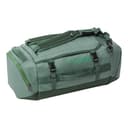
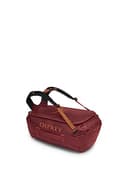
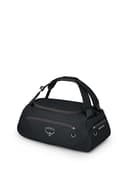
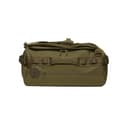
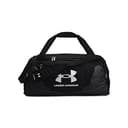
The duffel’s real advantage: it’s squashy
This is the argument nobody makes clearly enough. Airline sizers are rigid boxes; duffels are not. A 40L duffel packed to 32L collapses into whatever shape the sizer demands, while a 40L travel backpack with a frame sheet and structured panels holds its shape and gets flagged. In practice this means a duffel is often the more reliable carry-on, despite duffels being the bag people associate with checked luggage.
The corollary is that a duffel gives you no protection from your own overpacking. A structured pack tells you when it’s full because the zip stops closing. A duffel just keeps swallowing, right up to the point where it is a 55L bag wearing a 40L label and no longer fits anything. Weigh it before you leave.
Opening style decides how usable it is
The single most important duffel spec is how it opens, and there are two answers.
Top-loading (the classic gym duffel)
One zip along the top. Cheap, strong, and it buries whatever went in first. Fine for a bag you empty completely at each stop; frustrating for multi-city travel where you are living out of it.
U-zip or clamshell
The zip runs around three sides so the whole face folds open and the bag behaves like a soft suitcase. This is what makes 40L of duffel genuinely usable on a real trip, and it is the feature that separates travel duffels from gym duffels. If you are choosing between two duffels and one has a U-zip, that is usually the decision made.
Are the backpack straps real?
Nearly every duffel sold today advertises “convertible” backpack straps. There is an enormous quality range hiding under that one word, and it splits three ways:
- Webbing straps. Two flat straps clipped to the ends. They work for the walk from the carousel to the car park and become uncomfortable within about ten minutes. Most duffels are this.
- Padded stowable straps. Properly padded, shaped, and they tuck away behind a panel when you carry it by the handles. Good for twenty or thirty minutes with a moderate load.
- A genuine harness. Padded shoulder straps on a shaped back panel, occasionally with a sternum strap. This is a duffel-backpack rather than a duffel, and it will carry for as long as your shoulders hold out.
Note that even the third tier almost never has a hip belt, which is the feature that actually transfers load off your shoulders. That is the hard ceiling on duffel carry comfort, and it is why a long-walking, stairs-and-cobblestones trip still wants a travel backpack instead. Our backpack vs duffel guideworks that decision through in full. The nearest thing to an exception is a wheeled pack with a stowaway harness, which we put against this page’s Osprey duffel in Sojourn 45 vs Transporter 40.
What size duffel?
Duffel capacities run larger than backpack capacities for the same trip, because you lose organization and gain dead space around awkward items — the smallest bag we cover in this style, the Herschel Novel carry-on duffle, publishes 26.5L and still fills a personal-item box. As a rough guide:
- 30–35L: a weekend, or a carry-on for a light packer. Clears sizers easily.
- 40L:the carry-on sweet spot — a week with cubes, still squashable enough to make a sizer.
- 45L and up:past the honest carry-on line. Excellent checked bags and excellent gear haulers; don’t buy one expecting to fly it in the cabin packed full.
Cubes matter more in a duffel than in a backpack
A travel backpack’s clamshell and internal dividers do some organizing for you. A duffel does none — it is one cavity, and without structure it becomes a laundry pile within a day. Packing cubes are therefore close to mandatory here rather than optional: they turn the cavity into stacked, findable blocks and, as a bonus, give a soft duffel enough shape to sit squarely in a sizer. If you buy a duffel from this page, buy cubes with it.
When to buy a duffel instead of a backpack
Buy the duffel if: your trip is short; the bag will spend most of its time in a vehicle, boat or train rather than on your back; you need something that shrugs off abuse; you want a spare bag that packs flat for the outbound leg; or your itinerary has a strict sizer you are worried about. Buy the backpack if you will be walking with it loaded for more than about twenty minutes at a stretch. That single question — how far will I actually carry this? — settles it nearly every time.
There is one more case for the duffel, and it is the reason expedition bags are shaped this way: a duffel has no harness to protect and no frame to bend, which makes it the right bag for the hold. Can you check a backpack as luggage explains why straps and buckles are what baggage systems catch, and what to do when the bag going into the hold is a backpack anyway.