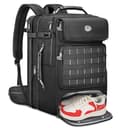
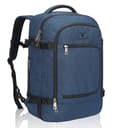
The criteria, and why they are in this order
1. Published fit, before anything else
Multiply the 22 x 14 x 9 inch allowance and you get 2,772 cubic inches, which is about 45 liters of totalspace — fabric, harness, hardware and air included. Hold that number next to a bag advertised as 45 liters of capacity and the arithmetic of this category becomes obvious: a 45-liter pack that fits a 45-liter box would have to be made of nothing. Every liter above roughly 40 is bought by going outside the box on some axis, and depth is the usual victim because it is the dimension a sizer catches most reliably.
2. About a week of clothes
Below 35 liters you are not one-bagging a week; you are one-bagging a long weekend, which is a different and easier problem — the packs for it are on best 30L travel backpacks. Above about 45 liters you have bought a checked bag with straps. The one-bag field is therefore narrow by definition, and that is why this page has six picks rather than ten.
3. A published laptop sleeve
With no personal item, the computer rides in the one bag. That makes a stated sleeve size a hard gate rather than a nice-to-have, and it eliminates packs quickly: of the six here, two state 15 inches, which means a 16-inch machine is not a published fit.
4. Empty weight
A one-bagger carries the bag through terminals, up stairs and across towns, and several carriers cap cabin weight outright. Emirates and Qantas publish 7 kg (15.4 lb) and Lufthansa 8 kg, so the empty weight is a fixed tax on everything you own.
5. Recourse
A bag that fails at home is an annoyance; one that fails abroad ends the trip the way you planned it. Three of the six carry a published lifetime-class warranty, one carries a limited term and two publish nothing.
The fit table, and the dimension nobody checks
Published exteriors against the 22 x 14 x 9 inch box, multiplied out:
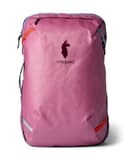
- Cotopaxi Allpa 35L — 22 x 12 x 10 in (2,640 cu in). Level on height, two inches inside on width, an inch over on depth.
- Nomatic Travel Bag 40L — 21 x 14 x 9 in (2,646 cu in). An inch inside on height, exactly level on width and depth. Nothing over, and no margin either.
- MATEIN 52L — 21 x 13 x 9 in closed (2,457 cu in), 10.5 in deep expanded (2,867 cu in).Inside on height and width, level on depth closed — then 1.5 in over on depth in the big mode, which is a checked size.
- Hynes Eagle 40L — 20.1 x 13.4 x 9.8 in (2,640 cu in). Nearly two inches inside on height, 0.6 in inside on width, 0.8 in over on depth.
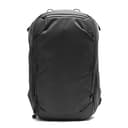
- Peak Design Travel Backpack 45L — 22 x 13 x 9.5 in (2,717 cu in) standard, 22 x 13 x 11 in (3,146 cu in) expanded.Level on height, an inch inside on width, half an inch over on depth standard — and two inches over expanded.
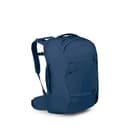
- Osprey Farpoint 40 — 21 x 15 x 10 in (3,150 cu in). An inch inside on height, an inch over on width and an inch over on depth. The largest published box on the page, on the pack this site recommends most often.
Now the thing that is almost never written down. Everyone argues about depth, and depth does matter — but look at the widthcolumn: 12, 13, 13.4, 14, 15 inches, against a 14-inch limit. An airline sizer is a slot, and a soft bag entering a slot compresses in the direction you push it, which is depth. Width is the dimension a bag cannot squeeze out of, because it is set by the back panel and the frame. That is why the Allpa’s two inches of width margin is worth more in practice than its one inch of excess depth costs, and why the Farpoint — over on width before you pack anything — is the one most likely to be told no. We make the same point from the other direction on carry-on backpacks that fit 22 x 14 x 9.
Two caveats we will not skip. A published depth is the bag’s fulldepth, so a soft pack carried under capacity measures less than its spec sheet — which is exactly why underpacking is the real one-bag skill. And a structured bag has no give at all: the Nomatic, level on two axes, will not compress its way out of trouble the way the Hynes Eagle will. Carrier-by-carrier numbers are in our carry-on size guide.
Two one-bag brands sell direct rather than through the retailer this site runs on, so neither appears above. The packs that answer one of them are on Tortuga Travel Backpack alternatives — where the original is one of very few 40-litre packs published inside the box on all three axes.
Weight, in liters per empty pound
From each maker’s published figures: Hynes Eagle 40L 18.2, MATEIN 52L 15.2 expanded (11.7 closed), Osprey Farpoint 40 12.9, Cotopaxi Allpa 35L 11.9, Nomatic Travel Bag 40L 11.7, Peak Design 45L 10.0 — and 7.8 if you fly it in its 35-liter standard mode, which is how Peak Design tells you to fly it. Against a 7 kg cabin allowance those packs spend 14, 22, 20, 19, 22 and 29 percent of the whole allowance on themselves, empty.
Twenty-nine percent is the number worth sitting with. On an Emirates or Qantas 7-kilogram cabin limit, the heaviest pack here consumes nearly a third of your allowance before a single shirt goes in — roughly 1.3 lb more than the Allpa and 2.3 lb more than the Hynes Eagle. For one-bag travel, where the bag is the luggage, that is not a rounding error; it is two days of clothes. The full table of every published empty weight we track, from 0.16 lb to 7.93 lb, is in how much a travel backpack weighs, and the airline caps themselves are in carry-on weight limits by airline.
The counter-argument is real and we will make it for the premium packs: weight buys structure, and structure is what lets a loaded bag transfer onto your hips instead of hanging off your shoulders. A 2.2 lb pack with a soft back panel and 30 lb in it is not more comfortable than a 4.5 lb pack with a frame. The mechanism is in why your backpack hurts your shoulders.
The laptop gate
Published sleeve sizes: MATEIN 52L 17.3 in, Peak Design 45L 16 in (plus a separate tablet sleeve), Nomatic 40L 16 in, Hynes Eagle 40L 15.6 in, Cotopaxi Allpa 35L 15 in, Osprey Farpoint 40 15 in. If you carry a 16-inch machine, the top two picks on this page are not a published fit for it, and that single column may override everything above.
Two honest notes about that number. It is a screen diagonal, not a measurement of your computer — a 15-inch sleeve may well swallow a thin 16-inch laptop and may refuse a thick 15-inch one, and only Peak Design publishes the actual internal maximum (16 x 11 x 1 in). And the large sleeves cluster at the budget end for a geometric reason rather than a generous one: a 17.3-inch sleeve needs a tall flat panel, which is easy in a cheap 21-inch pack with one big cavity and hard in a premium bag whose back panel is full of frame. The whole field on that axis is on best travel backpacks for a 17-inch laptop.
Which one, by the way you travel
You fly strict European carriers
Cotopaxi Allpa 35L, for the width margin. Ryanair, easyJet and Wizz publish their own smaller allowances, and a narrow bag with an inch of excess depth that you can underpack beats a wide bag that is over before you start. Pack it below capacity and treat the published depth as the ceiling, not the target.
You will walk with it loaded
Osprey Farpoint 40. It is the only pack here with a published padded hip belt anchored to a structured back panel, plus the All Mighty Guarantee, which Osprey honors on any product from any era. Accept that it is the worst published fit on the page and plan to fly it sensibly packed, or take the women’s-fit Fairview if the harness has ever sat too tall on you — the pair is settled on Farpoint vs Fairview.
You carry tech and want everything in its own place
Nomatic Travel Bag 40L. It is the only pack here with no published axis over the box, it converts to a duffel without repacking, and it states a 16-inch sleeve in a dedicated padded tech compartment with a lifetime warranty behind it. It is also the heaviest fixed-volume pack we cover, and a structured bag has no squeeze in reserve.
Your trip changes size
Peak Design Travel Backpack 45L — 35 liters out, 45 home, with four access doors and a lifetime warranty. Fly it in standard mode and treat the expanded bag as checked, because 11 inches of depth is not a carry-on anywhere. It is the heaviest non-wheeled bag on this site, which is the price of the hardware. If that price is why you are here, we lay out the whole field of substitutes on Peak Design Travel Backpack alternatives.
You want the most bag for the least money
MATEIN 52L Expandable. Closed it is inside the box on height and width and level on depth; expanded it is 1.5 inches over and should be checked. It ships with three packing cubes and a toiletry bag, states a 17.3-inch laptop compartment and a vented shoe section, and publishes neither a fabric nor a warranty term — which is the trade at this price, stated plainly.
You one-bag twice a year
Hynes Eagle 40L. A 40-liter clamshell with a hip belt and compression straps at 2.2 lb, for a fraction of any premium pack, and the most weight-efficient bag on this site at 18.2 liters per empty pound. No published warranty and no named fabric, so treat it as a few-years bag rather than a buy-it-for-life one. It is also our value pick on travel backpacks under $100.
Three things that make one-bag work better than a better bag does
Worth saying on a page that is trying to sell you a backpack, because the bag is the smaller half of the problem.
- Underpacking beats compressing. A soft bag measures its published depth only when it is full. The single most reliable way to clear a sizer is to leave the last three inches of the clamshell empty, which no purchase can do for you.
- A laundry plan replaces about four liters.One wash mid-trip is the difference between a week and two in the same bag, which is the honest reason a 40-liter pack can cover a fortnight — the arithmetic is on best travel backpacks for two weeks.
- Cubes buy order, not space. Compression sets genuinely reduce the volume of soft clothing; plain cubes mostly make a one-bag trip findable, which matters more than it sounds when the bag is also your wardrobe. We put real numbers on the difference in are packing cubes worth it.
What we are not claiming
We own none of these packs and have not run them side by side. Every dimension, weight, sleeve size, material and warranty term above is the manufacturer’s own published figure, read from its own page or listing on a dated visit and cited in the sources below; where a maker publishes nothing we print “Not published” rather than an estimate. The carry-on verdicts are our own read of those published numbers against the airlines’ own published limits, stated as a read rather than as a manufacturer claim. There are no ratings, test results or awards on this page, because we have not run any.