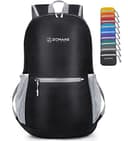
Capacity per pound, where this category is absurd
Run the arithmetic the rest of this site runs on full-size packs and the numbers stop looking like the same hobby. Capacity per empty pound, from the makers’ published figures:
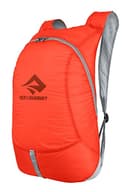
- Sea to Summit Ultra-Sil 20L — 0.16 lb. About 125 liters per pound.
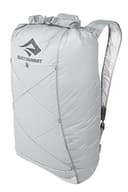
- Sea to Summit Ultra-Sil Dry Day Pack 22L — 0.24 lb. About 92 liters per pound, and it is genuinely waterproof, which normally costs far more weight than this.
- Hynes Eagle 40L — 2.2 lb. 18.2 liters per pound, and the lightest full-size travel pack we cover at any price.
- Osprey Farpoint 40 — 3.1 lb. 12.9 liters per pound.
Against the 7 kg (15.4 lb) cabin allowance Emirates and Qantas publish, the Ultra-Sil spends about 1 percent of your allowance and the Dry Day Pack about 1.6 percent. That is the real argument for carrying one: on the carriers that weigh your bag, a packable day pack is close to free, where a structured daypack is a meaningful fraction of what you are allowed. The allowances by airline are in carry-on weight limits by airline, and whether a second bag is allowed at all is in can I bring two backpacks on a plane.
Packed size, and a listing claim the maker’s own figure disproves
Sea to Summit states the Ultra-Sil 20L packs to 5.5 x 10.2 x 18.6 cm — about 2 x 4 x 7 inches, which multiplies to roughly 56 cubic inches, or one liter. The honest description is a one-liter bottle laid flat.
Worth knowing, because the retail listing for the same bag says it “packs down to the size of a tennis ball.” A tennis ball is about 0.16 liters. The maker’s own published figure is roughly six times that, so the listing claim is wrong by about 6x and we are not going to repeat it. One liter is still an excellent result — it is a cup of space out of a 40-liter bag — but it is not a tennis ball, and this is the kind of claim worth checking against the manufacturer before you buy anything in this category.
Nobody else here publishes a packed size. The ZOMAKE states that it packs into its own pocket and nothing more; Vera Bradley publishes neither a packed size nor a weight; MARCHWAY publishes neither. For the MARCHWAY the shape of the answer is at least obvious — it is a roll-top dry sack with straps, so there is nothing inside it to hold a shape and it folds flat — but obvious is not published, and the table says so.
What you give up, in every case
All five of these bags are frameless and unpadded or nearly so, and that is structural rather than a cost saving. A bag that folds to a liter cannot contain a frame sheet, a padded belt or a laptop compartment, because all three of those are rigid. The consequences are consistent across the category:
- Thin straps bite under load. Twenty liters of clothes is fine; twenty poundsis genuinely uncomfortable in any of these, and the ZOMAKE’s unpadded straps are explicit about it.
- No laptop protection.None of these states a laptop size, and none has a padded sleeve to state. A packable day pack is for a camera, a jacket, water and a market haul — not for carrying a machine around a city.
- Water-resistant is not waterproof.Sea to Summit’s own guidance on the Ultra-Sil is that it is water-resistant only, with unsealed seams and an uncovered zipper — which is exactly why the Dry Day Pack, with taped seams and a double roll-top, is the separate pick. The three requirements for a bag that genuinely keeps water out are in what makes a backpack waterproof.
Does a packable bag fly as a personal item?
Usually yes, and this is the one place on this site where our standing rule — published dimensions settle the fit question — does not apply. The Ultra-Sil’s unpacked exterior is published at 19 x 8 x 11 inches, which sorted largest-first is over Southwest’s longest side by half an inch, over the common 18 x 14 x 8 inch personal-item box by an inch, over JetBlue’s by two, and well over Ryanair’s free-bag allowance. None of that matters much, because there is no frame, panel or fixed shape: a 30-denier sack becomes the space you put it in.
What does matter is the airline’s rule on how many bags, not how big they are. Both sets of published limits are in personal item vs carry-on, and what to put in the smaller bag is in the personal item packing list.
Who should buy which
A spare bag for day trips and markets
Sea to Summit Ultra-Sil 20L if you care about weight and space; the ZOMAKE if you care about price. The honest comparison is that the ZOMAKE states the same 20 liters and packs into its own pocket, and the gap is in published evidence and in fabric: Sea to Summit names a 30D siliconized high-tenacity Cordura nylon, ZOMAKE names “water-resistant nylon.” If weight genuinely does not matter to you, buy the cheap one — that is the correct call, not a compromise.
Boat days, rain and anything that gets wet
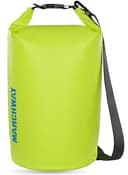
The Ultra-Sil Dry Day Pack 22L for a day’s kit, the MARCHWAY 40L if you are hauling wet gear rather than carrying a camera. The MARCHWAY floats when sealed, which is the point of the category, and its straps are basic enough that it is a sack you can wear rather than a pack you would hike in. The structured-waterproof field is waterproof travel backpacks.
A second bag you would carry to dinner
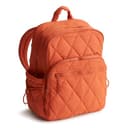
Vera Bradley Featherweight Bancroft. It is light and packable and looks like a bag rather than a piece of gear, which is a real requirement and one the technical packs cannot meet. It publishes no capacity, weight or dimensions, so the table is mostly empty rows — buy it for how it looks, which is what it is for, not because we can show you it is the most efficient.
What a packable pack is not
It is not a main bag. Twenty liters with thin straps and no frame will carry three days of clothes in the sense that they fit, and will be unpleasant for the entire walk. If you want one bag for the whole trip, the smallest honest answer is the 30L class, and the lightest full-size packs are on best lightweight travel backpacks. And if the appeal here is minimum volume rather than minimum weight, best minimalist travel backpacks is the page that argues it properly.