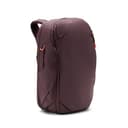
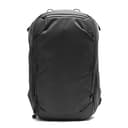
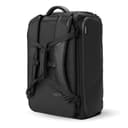
Every published mode, in one place
This is the table Peak Design’s own product pages give you, consolidated. The carry-on column is measured against 22 x 14 x 9 in — the box American, Delta, United, JetBlue and Alaska all print.
- 30L, standard: 27 L of capacity, 53 x 33 x 18 cm = 20.9 x 13 x 7 in. Inside the box on all three sides, with 1.1 in of height margin, 1 in of width and 2 in of depth.
- 30L, expanded: 33 L, 53 x 33 x 20 cm = 20.9 x 13 x 7.9 in. Still inside the box, with more than an inch of depth margin left.
- 45L, cinched: 30 L, in the same 22 x 13 in footprint. Peak Design does not publish a separate cinched depth.
- 45L, standard: 35 L, 22 x 13 x 9.5 in. Level on height, 1 in inside on width, 0.5 in over on depth.
- 45L, expanded: 45 L, 22 x 13 x 11 in. 2 in over on depth— not a carry-on on any airline we track.
Two things fall out of that list. The first is that the 30L is the only expandable pack on this site whose published dimensions sit inside the standard box in every mode, which makes it a genuinely unusual bag. The second is that the 45L’s useful carry-on configuration is its 35-liter standard mode, which Peak Design itself labels the maximum carry-on size — so the 45 in the name describes the mode you are meant to fly home in, not out.
Weight, and what it costs per liter
3.17 lb against 4.5 lb. Stated as capacity per pound of pack — the only fair way to compare two bags of different sizes — the 30L carries 8.5 L/lb standard and 10.4 L/lb expanded; the 45L carries 7.8 L/lb standard and 10.0 L/lb expanded. They are close, and they are both poor. For context, the tomtoc 40L does 15.1 L/lb and the Hynes Eagle 40L does 18.2.
That is the real cost of this build quality, and it is worth being blunt about it: both Peak Design travel packs are among the heaviest packs per liter we cover, because metal hardware, a coated shell and four access doors weigh something. Where it bites is a cabin weight limit. Emirates and Qantas publish 7 kg (15.43 lb): the empty 30L spends 21 percent of that, the empty 45L 29 percent. Lufthansa publishes 8 kg (17.64 lb) and Ryanair 10 kg. Our cabin weight guide has every published limit we track, and the weight guide tables every empty weight on this site.
Harness: the difference nobody mentions
Neither pack ships with a hip belt. On the 30L, Peak Design states the hip belt as an optional accessory; on the 45L it states none. Both have tuck-away shoulder straps and a stowable sternum strap, and the 30L ships with two Cord Hook external carry straps in the box.
What that means in practice: the load rides on your shoulders on both. At 27 liters of clothes that is fine for most people. At 45 liters of winter clothing or camera gear it is the single best argument for buying a different bag entirely, because a belt that transfers weight to your hips is the one feature that changes how a heavy pack feels over an hour on your feet. Our hip-belt roundup lists only the packs whose maker states a load-bearing belt, and the shoulder-pain guide explains the mechanism.
The warranty, in Peak Design’s own words
Identical on both packs, and worth reading before you buy either: Peak Design’s lifetime warranty covers manufacturing defects and failures or breakages that render part or all of the product non-functional. It explicitly excludes cosmetic wear, misuse, apparel, Factory 2nds — and products bought on secondhand marketplaces or auction sites. That last clause is the one that catches people: a Peak Design pack bought used is not covered, which changes the math on buying either of these secondhand.
Who should buy which
Buy the 30L if
- Your trips are three to five days, or you pack light and fly often.
- You fly routes where the bag is measured — European budget carriers, regional jets, anything with a frame at the gate. This is the stronger reason, and it applies in both modes.
- You want the Peak Design build for a laptop and a camera body rather than for clothing volume. The 16-inch sleeve and 10-inch tablet pocket are the same as the 45L’s.
Buy the 45L if
- You genuinely use the expanded mode — coming home with more than you left with, or carrying bulky cold-weather layers.
- You want one bag to cover a weekend and a two-week trip, and you will fly out in standard mode and treat the expanded bag as checked.
- Four-door access matters to you more than weight. Nothing else on this site opens from the rear, front, side and top.
Buy neither if
You want premium organization, more capacity than either, and a published exterior inside the carry-on box. The Nomatic Travel Bag 40Lpublishes 21 x 14 x 9 in — inside 22 x 14 x 9 on every side — at 40 liters, 3.42 lb and a 16-inch laptop sleeve, with its own lifetime warranty. It is the compartment-heavy premium pack that does not have a depth problem. Our premium roundup covers that tier, and the Nomatic against the Peak Design 45L is the head-to-head if that is now your real decision.
What the specs cannot tell you
How much of the 30L’s 27 liters you actually use once a 16-inch laptop is in the sleeve. Whether the expansion zip on either pack stays easy after two years of being cycled. Whether the rear clamshell, which has to be laid flat to open on the 30L, is annoying in a hotel room or a non-issue. None of those are published figures, and we have not flown either pack, so none of them appear above as a claim.