The dimension that decides it
Put the two published figures next to the box every major US carrier prints on its sizer, 22 x 14 x 9 in:
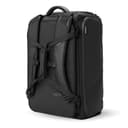
- Nomatic Travel Bag 40L — 21 x 14 x 9 in. One inch under on height, level on width, level on depth. Nothing is over.
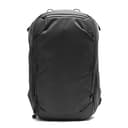
- Peak Design Travel Backpack 45L — 22 x 13 x 9.5 in standard, 11 in deep expanded. Level on height, a full inch under on width — which is genuinely good, because width is where a lot of the 40L field runs 15 in and gets stopped — and half an inch over on depth before you touch the expansion zip.
Half an inch sounds like nothing, and in a bin it is nothing. At a rigid sizer it is the difference between walking through and being asked to try. Peak Design is not hiding this: the brand describes the 35L standard mode as the maximum carry-on configuration, and the 45L mode exists for the journey where the bag gets checked. Our Peak Design Travel Backpack 45L review works through that math in full.
There is a second-order point in the Nomatic’s favor and against it at the same time. It is structured: a rigid, compartmentalized body with no give. A soft bag that is nominally over a limit frequently squashes into a sizer; a structured bag at exactly the limit does not squash, so it has to actually fit. Nomatic’s numbers do fit, but there is no margin in them, which means an overfilled front pocket is the failure mode to watch rather than the shell.
Weight, and the allowance you cannot see
Nomatic publishes 3.42 lb. Peak Design publishes 4.5 lb. On a US carrier that does not weigh cabin bags, that difference is a pound you carry and nothing more. On Emirates or Qantas, where Economy caps the cabin bag at 7 kg including the bag itself, 4.5 lb is about 29 percent of the allowance gone before a single shirt goes in, against about 22 percent for the Nomatic. That is roughly a kilo and a half of clothes, which is a lot on a one-bag trip.
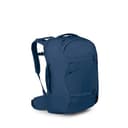
Neither bag is light in absolute terms. Both spend their weight on structure and hardware rather than on a frame and a harness, which is the recurring theme of this comparison: these are bags optimized for being organized and opened, not for being carried. For context, the Osprey Farpoint 40 on this page is 3.1 lb with a frame and a padded belt, and the tomtoc 40L is 2.65 lb. The carrier-by-carrier weight figures are in carry-on weight limits.
How you get into them, which is the real difference in daily use
The Nomatic opens like a suitcase and converts between duffel and backpack carry without repacking, and its interior is a grid of structured compartments with a separate, well-padded laptop and tablet section. The idea is that every object has one home. If you are the kind of traveler who knows which pocket the charger lives in, this is designed for you; if you pack in cubes and like one big space, you are paying for structure you will not use.
The Peak Designopens four ways — rear, front, both sides and the top — so nothing is ever buried regardless of how you packed it. That is the best access of anything we cover, and it is the single strongest argument for the bag. The catch is that the layout is designed around Peak Design’s own packing cubes, camera cubes and pouches, and all of those are sold separately. Budget for them or the interior is emptier than the marketing photos suggest.
Both state a 16-inch laptop sleeve, so neither is an option if your laptop is 17 inches — that market is covered on best travel backpacks for a 17-inch laptop, and it is almost entirely budget brands.
Materials and warranty, read properly
Peak Design publishes the more detailed specification: a weatherproof 100 percent recycled 400D nylon shell over a 900D waterproof bottom liner, anodized aluminum and glass-reinforced nylon hardware. Nomatic publishes a water-resistant polyester and nylon construction and a reputation for structure and hardware quality. On the fabric spec sheet, Peak Design wins on disclosure.
Both offer a lifetime warranty, and this is where reading the terms is worth two minutes. Peak Design’s own warranty page covers manufacturing defects and failures or breakages that render part or all of the product non-functional, and explicitly excludes cosmetic wear, misuse, Factory 2nds and anything bought on a secondhand marketplace or auction site. That is a normal, reasonable set of exclusions — and it means a scuffed shell or a frayed strap edge is yours to live with. Nomatic states a lifetime warranty on the bag. Osprey’s All Mighty Guarantee, for comparison, is a repair-or-replace commitment with no time limit on any product from any era, which is the most generous policy of the three. What a warranty is actually worth over years of use is the subject of how long travel backpacks last.
Why there is a third bag on this page
Because neither of these two states a padded, load-bearing hip belt. Peak Design sells a hip belt for its Travel Backpacks as a separate accessory and states that the pack has no frame; Nomatic’s published specification does not include one. Both are therefore shoulder-carry bags, which is entirely fine for airport-to-hotel travel and increasingly unpleasant above about 15 lb over a long walk.
The Osprey Farpoint 40 costs less than either, weighs 3.1 lb, and has a padded belt anchored to a structured back panel that moves weight onto your pelvis — plus the best warranty of the three. What you give up is organization (it is one big clamshell, and you will want packing cubes), the laptop sleeve drops to 15 in, and its published 21 x 15 x 10 in is wide and deep enough that a strict European sizer is a real risk. That is a genuine trade, not a free upgrade. The whole field of bags with a real belt is on best travel backpacks with a hip belt.
Buy rules, stated flatly
- You fly carriers that use a rigid sizer, and the bag must come in the cabin. Nomatic. It is the only one of the three with no dimension over the limit.
- Your trips range from two nights to two weeks and you will check a bag. Peak Design. 30L to 45L in one shell is a real capability nothing else here has.
- You walk more than ten minutes with the bag loaded. Osprey Farpoint 40, or another bag with a belt. Neither premium pack solves this and no amount of organization compensates.
- You shoot photos and own Peak Design cubes already. Peak Design. The four-way access and the cube ecosystem are the entire point of that bag.
- Your laptop is 17 inches. Neither. Both state 16 in.
- Weight is capped at 7 kg on your route. Nomatic over Peak Design, by about a pound of empty bag.
What we did not test
Everything above is read from what the two makers publish about their own products, plus the airline pages cited below. We do not own either bag, we have not flown them, and there is no score on this page because a number would make spec-reading look like testing. Where a figure is contested or conditional — the Peak Design’s depth in its three modes, the Nomatic’s lack of give at a sizer — we have said so rather than rounding it away. Our full method is in how we choose.