What Pacsafe actually publishes, and what the alternatives do
Four security features are worth separating, because listings use them interchangeably and they are not equivalent:
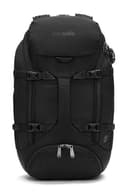
- Slash-resistant construction. A cut-resistant layer in the bag body, and sometimes the strap. Pacsafe names it: an eXomesh slashguard in a 750D recycled polyester shell on the Metrosafe X. Travelon states slash-resistant body panels and a slash-resistant strap, but names no material at all. Neither budget pick claims it, and we do not credit it to them.
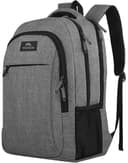
- Locking hardware. Zipper pulls that clip or lock so a bag cannot be opened behind you. Pacsafe and Travelon both publish it. The MATEIN states a lockable main compartment.
- RFID-blocking pockets. Published on both Pacsafe bags and the Travelon. Cheap to include and the least important of the four in practice.
- A concealed pocket.The budget interpretation of “anti-theft,” and the one worth discounting hardest — a hidden back pocket is a convenience, not a security system. Both budget picks here are in this tier and we say so on their cards.
Ranked by how much is published rather than implied, the order is Pacsafe, Travelon, then everything else — and that is exactly the order of this page.
The strap, which is the finding most write-ups miss
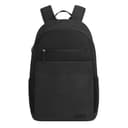
Travelon publishes a slash-resistant shoulder strap. That is worth more than its position in this list suggests, because the realistic attack on a bag you are actively wearing is not someone cutting through the back panel — it is a strap cut, which takes a second and removes the whole bag. A cut-resistant body with an ordinary webbing strap solves the less likely half of the problem.
Pacsafe’s own answer is a system rather than a single part — mesh, locking pulls and in some models anchoring a strap to a fixed object — and Pacsafe names what the mesh is, which Travelon does not. Both are defensible positions. The honest summary is that Travelon gives you the attack surface that matters most at a materially lower price, and Pacsafe gives you a material you can actually look up.
Capacity, and the mistake buyers make here
Published capacity splits this field more than security does. The Metrosafe X is 20 liters and the Travelon is 14 — roughly two thirds of it. Both are personal-item sized day bags, which is correct for the job, but 14 liters is genuinely small: a jacket, a 15.6-inch laptop, water and a day’s bits, not a camera kit plus a change of clothes.
Nobody arriving at “best anti-theft travel backpack” is shopping for a day bag, which is why the only full-size option in this field is the Pacsafe Venturesafe EXP35 — 35 liters with the same construction philosophy, and priced like a premium travel pack and a security bag combined, which is roughly what it is. If that is what you need, the alternative to a Pacsafe is a bigger Pacsafe, and we would rather say that than pad the page.
The option this category rarely mentions: lock the bag you already want
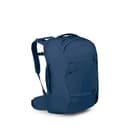
For a main travel bag, the realistic alternative to buying anti-theft construction is buying an ordinary pack and locking it yourself. Any double-pull zip takes a small travel lock through the two pulls; a clamshell that opens on one long zip run is the easiest shape to do it on. Osprey does not publish a lockable-zip feature for the Farpoint 40 and we do not credit it with one — what it does publish is a 40-liter clamshell, the All Mighty Guarantee, and the load-bearing hip belt that none of the security bags on this page offer: a shaped, padded belt on a structured back panel, which is what you feel on a twenty-minute walk with a full bag.
A lock on a zip does not stop a blade. What it stops is the overwhelmingly more common event: a hand in your bag on a train, or a hostel room-mate with five unsupervised minutes. Pair it with a cable lock through the haul loop and you have covered most real risk without carrying security hardware on every trip you will ever take. The method, including which zip types actually accept a lock, is in how to lock a backpack, and the security tiers in full are on best anti-theft travel backpacks.
Weight and warranty, where the trade is clearest
Capacity per empty pound, for the two bags here that publish a weight: Pacsafe Metrosafe X 10.7 liters per pound, Travelon 8.5. The lighterbag is the less efficient one, which is the security tax paid twice on a small bag — panels and locking hardware cost roughly the same whatever volume they wrap, so the smaller the bag, the worse the ratio looks. Against the 7 kg (15.4 lb) cabin allowance Emirates and Qantas publish, they spend 12 and 11 percent of it empty, which is a non-issue for a day bag either way. Figures by carrier are in carry-on weight limits by airline.
Warranty is the other clean difference, and it runs the same direction as price. Pacsafe publishes a 5-year limited warranty on the Metrosafe X. Travelon publishes 2 years on anti-theft bags in the US and Canada — the shortest term among the anti-theft bags we cover, limited to the original owner and original purchase, and voided by removing the internal manufacture label, which is also how the clock is set if you have lost the receipt. The MATEIN and the LOVEVOOK publish no term at all, and the Venturesafe EXP35’s listing publishes none either, so the table prints “Not published” for all three rather than assuming the brand-level policy covers them.
Which alternative, by reason for leaving
“Too expensive”
Travelon Anti-Theft Metro Backpack. It is the only alternative that publishes slash-resistant construction at all, and the only bag on the page that publishes a slash-resistant strap. Accept 14 liters instead of 20, a 2-year warranty instead of 5, and a weave the maker will not name. The full write-up is the Travelon Metro Backpack review, and the direct head-to-head is Pacsafe Metrosafe X vs Travelon Metro.
“I want a much cheaper bag and I know what I am giving up”
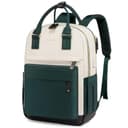
MATEIN Travel Laptop Backpack, or the LOVEVOOK if you want something that reads as a work bag rather than gear. Both are concealed-pocket bags with a 15.6-inch sleeve and no slash-resistant claim, and both publish no capacity, weight, dimensions or warranty. That is a real downgrade in kind, not just in degree, and it is the correct purchase only if your actual worry is a hand in an outer pocket rather than a knife. The budget field around them is best travel backpacks under $50.
“I need a main bag, not a day bag”
Pacsafe Venturesafe EXP35 if you want the construction, Osprey Farpoint 40 if you want the carry and will add your own lock. There is no cheap third option here, and anyone offering you one is selling a hidden pocket. For the full 40-liter field see best 40L travel backpacks, and for what else answers the Farpoint brief, Osprey Farpoint 40 alternatives.
“I want it to carry comfortably”
None of the dedicated security bags has a load-bearing hip belt, and that is structural rather than an oversight — slash-resistant panels and a frame compete for the same space and weight budget. If you are walking with a full load, the Farpoint is the pick and the mechanism is in why your backpack hurts your shoulders.
Where to spend, if you only spend once
Buy the security on the bag you carry all day, keep the main bag ordinary and lockable, and spend what is left on packing cubes rather than on a second security product. That ordering is not the one this category advertises, and it is the one that matches where theft actually happens. If your trip is a single city with a genuine reputation, the day bag alone is enough; if it is six weeks across a dozen of them, the Venturesafe is the only bag here that covers both roles. The price bands either side of these picks are best travel backpacks under $150 and best travel backpacks under $200.
What we are not claiming
We own none of these bags, have not cut, slashed or stress-tested any of them, and nothing on this page is a test result. Every capacity, weight, dimension, sleeve size and warranty term is the manufacturer’s own published figure, read from its own page or listing on a dated visit and cited in the sources below. Security features are credited only where the maker states them — never inferred from a product photo or a listing bullet that says “anti-theft.”