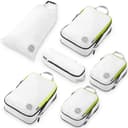
How cubes fit a backpack, not a suitcase
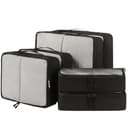
Picture a 40L clamshell open flat. You have a main cavity roughly the footprint of a piece of A3 paper and a few inches deep, plus a lid compartment that is shallower. Cubes fill that well only if they stack in layers: two mediums side by side, or one large across the bottom with smalls on top.
The failure mode is the extra-large cube that comes in most sets. In a suitcase it is the workhorse; in a 35–40L pack it usually only fits one way round, and once it’s in you can’t get anything else flat. Our advice for a carry-on is blunt: use two mediums and two smalls, and leave the XL at home.
How many cubes do you actually need?
For a week in a 40L pack, four is plenty, and they should be assigned by category rather than by day:
- Medium 1 — tops. Shirts and t-shirts, folded flat, the layer that lives at the bottom.
- Medium 2 — bottoms and layers. Trousers, a jumper, anything bulky.
- Small 1 — underwear and socks. The cube you open daily, so it goes on top.
- Small 2 — laundry.Starts empty and fills as the first two empty. This is the cube people forget, and it’s the one that keeps a bag civilized on day five.
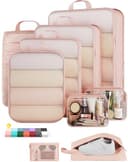
A six- or eight-piece set is still worth buying, because you get the right four plus spares for a partner or a different trip shape. What isn’t worth doing is filling the bag with eight cubes: every cube adds fabric, zips and edges, and past about four you are packing your packing.
Compression, and what it actually costs
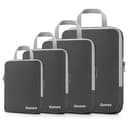
A compression cube has a second zip that squeezes the packed cube flatter. In a carry-on it does something specific: it removes air, which is most of the volume of soft clothes. That converts three cubes of fluffy knitwear into two cubes of dense knitwear.
The costs are equally specific, and every honest review should state them. Wrinkles, because pressure and creases go together — keep shirts out of the compression cube. Weight discipline, because compressing lets you carry more than your back or your airline’s scale wants. Zip strain, because a compression cube is a zip pulling against packed fabric, and cheap zips fail there first.
The sensible carry-on setup is mixed: standard cubes for anything you want to look presentable, compression cubes for knitwear, fleece and dirty laundry on the way home. Our cubes vs compression bags guide takes the argument further, and BAGAIL vs Gonex compares the two styles head to head at nearly the same price.
What separates a good cube from a bad one
The zipper
Cubes fail at the zip, essentially always. Look for a zip that runs three-quarters of the way around rather than half — a half-round zip means you cram clothes in through a slot — and for pulls big enough to grab with cold hands. Branded zips (YKK and peers) are worth a small premium on a cube you will use fifty times.
The mesh
Mesh tops let you see the contents and let clothes breathe, which matters if anything went in slightly damp. Solid tops are more durable and hide the mess. Premium sets increasingly use a window — a panel of mesh in a solid face — which is a genuine improvement rather than a styling exercise.
The seams and the corners
Bound seams last; raw overlocked seams fray. The corners are where a stuffed cube pushes hardest, and it’s where cheap sets split. This is most of what you are buying when you spend four times as much on a premium set — that, and a warranty.
Is a premium set worth it in a carry-on?
Honestly: only if you travel often. The functional gap between a budget six-set and a premium three-set is small on any single trip — both hold clothes, both zip shut, both organize a bag equally well. The gap shows up over years, in seams that don’t fray and a zip that still runs.
If you fly a few times a year, buy the cheap set and spend the difference on shoe bags and a better toiletry bag, which will improve your packing more. If you travel monthly, the premium set is a reasonable buy and the warranty is real. We’d rather say that than pretend cubes are a category where spending more transforms the experience.
Cubes and the sizer
One caution that applies specifically to carry-on use: cubes make a soft bag rigid. A pack full of neatly packed cubes cannot be squashed into a sizer the way a loosely packed one can, so the bag that measured fine at home measures exactly the same at the gate — which is good if you sized it properly and bad if you were relying on squashing it. Measure the packed bag once, the way a gate agent will, using our how to measure a backpack guide.
The mistake buyers make
Buying an eight-piece set because it looks like better value, then using all eight. More cubes means more fabric, more zips and more wasted edge space in a bag that has none to spare. Four cubes, assigned by category, is the carry-on answer.