The finding inside Osprey’s own numbers
Multiply the 22 x 14 x 9 inch allowance the US majors publish and you get 2,772 cubic inches — about 45 liters of total space, the bag’s own fabric, frame and harness included. Run Osprey’s published exteriors against it and the result is not the one the price list predicts:
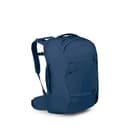
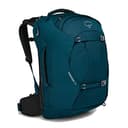
- Fairview 40 — 21.3 x 13.8 x 9 in (2,645 cu in). Inside on height, inside on width, exactly level on depth. The only pack in the range inside the box on all three axes, which means the shorter-torso pack is also the more carry-on-legal pack.
- Farpoint 40 — 21 x 15 x 10 in (3,150 cu in). Inside on height by a full inch, but over a 14 in width limit by 1 in and a 9 in depth limit by 1 in. Two axes out, on the pack everyone buys.
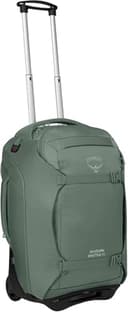
- Sojourn 45 — 22 x 14 x 9 in packed, 23.2 x 16.9 x 13 in overall. Exactly the box when packed down, with zero margin; over on all three sides at its overall dimensions, which multiply to more than 5,000 cubic inches.
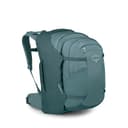
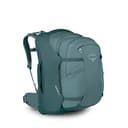
- Fairview 55 — 24.6 x 13 x 11.8 in. Over on height by 2.6 in and depth by 2.8 in.
- Farpoint 55 — 25 x 13 x 12 in. Over on height by 3 in and depth by 3 in. Both 55L packs are honest about this: they are a 40L pack with a 15L daypack zipped on, for a trip you check or gate-check.
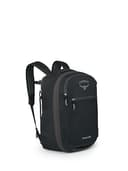
- Daylite Expandable 26+6.Osprey publishes no exterior dimension for it, so the table prints “Not published” rather than an estimate. Expanded it stops being reliably personal-item sized — zip it down to fly.
Depth is where this category fails, consistently. Height and width are cheap for a designer to respect; liters are won by going deeper, and the sizer measures depth too. If a strict European carrier is your route, start from the packs that fit 22 x 14 x 9 rather than from a liter figure.
Which Farpoint or Fairview is the real question
Choose by torso length, not by height and not by the label on the box. Osprey’s Fairview line is a fit spec: a shorter back panel and narrower, contoured shoulder straps, which is a genuine benefit for a shorter torso or narrower shoulders whoever you are, and no benefit at all if a standard harness already fits. Measuring yours takes two minutes — the torso-fit guide walks it, and women’s carry-on backpacks by torso size maps the bands to packs.
The weight penalty for the women’s fit is 0.1 lb on the 40s and nothing at all on the 55s — Osprey publishes the Fairview 55 at 3.8 lb against the Farpoint 55’s 3.9 lb. Fit is effectively free in this range, which is unusual and worth knowing.
40 or 55 liters: the question is the hold, not the trip length
A 55L Osprey is not a bigger carry-on. Its published exterior is over the standard box on two axes by about three inches, and no amount of compression fixes three inches of height. So the 40-versus-55 decision is really: are you flying with a checked bag anyway?
If yes, the 55s are good value — they are also the most efficientpacks in the range. Capacity per empty pound: Fairview 55 carries 14.5 liters per pound, Farpoint 55 14.1, Farpoint 40 12.9, Fairview 40 12.5, Sojourn 45 just 6.0. The big packs give you more liters for each pound you carry, because a harness and frame cost roughly the same whether they sit on a 40L or a 55L body. Against the 7 kg (15.4 lb) cabin allowance Emirates and Qantas publish, these five spend 20, 21, 25, 25 and 49 percent of it empty — and that last figure is the whole case against wheels. Details in carry-on weight limits by airline.
The Sojourn, and when wheels are worth 4.4 lb
The Sojourn 45 is the only pack here that rolls, and at a published 7.5 lb it is more than twice the empty weight of a Farpoint 40 for five more liters. That is the exchange rate, and it is only worth paying under one condition: that the ground you cross is flat and paved, and that you will genuinely use the harness for the parts that aren’t. Roughly two to three pounds of extra empty bag buys about twenty pounds off your body on flat ground — a good trade on an airport concourse, a bad one on station stairs. The full write-up is the Sojourn 45 review, and the wider field is carry-on backpacks with wheels.
One honest note on Osprey’s own figures for this pack: its imperial and metric spec blocks disagree on which axis is which, and 59 cm / 23.23 in is the height rather than the depth. We print the resolved reading and say so.
Osprey packs we did not rank, and why
Two Osprey bags in our registry returned no buyable offer on the most recent price refresh and are therefore not ranked here: the Transporter 40L duffel and the Daylite Duffel 45. Both are real products with real reviews on this site; neither is something we will put a top slot behind while it has no price to show. The Fairview 40 is ranked second despite also returning image-only on recent refreshes, because it is the right recommendation for a shorter torso and its card falls back to a direct check-price link rather than a number.
Osprey’s hiking line — Atmos, Aether, Exos — is deliberately out of scope. A hiking pack is a top-loader built around a frame and a trail; a travel pack is a clamshell built around an airline sizer. The difference, and the cases where the hiking pack is still the right buy, is in travel backpack vs hiking backpack.
Is an Osprey worth it?
It depends almost entirely on how often you fly. On published specs, a $44 Hynes Eagle 40L is 0.9 lb lighter than a Farpoint 40, carries the same 40 liters and is over the standard box on one axis instead of two — we run that comparison honestly in Hynes Eagle 40L vs Farpoint 40, and the cheap bag wins on every published number. What Osprey sells is the three things that are not specs: a belt anchored to a structured panel, materials and hardware that survive the fortieth trip, and a guarantee that gets a failed bag repaired instead of replaced out of your pocket. For a few trips a year, buy cheaper. For constant travel, this is the range to buy from — and the alternatives, if you want to shop around first, are on Osprey Farpoint 40 alternatives.