The number that actually decides it
Before you compare packs, decide which airlines you are flying, because Europe has two entirely different rulebooks running side by side.
Legacy and major carriers
British Airways, Lufthansa, Air France, KLM and the transatlantic majors all allow a genuine cabin bag in the 55 x 40 x 20 cm region — broadly comparable to the US 22 x 14 x 9 inch standard. If your entire itinerary is on carriers like these, a 40L travel backpack is fine and you can pick from our main roundup without much anxiety.
Budget carriers
Ryanair, easyJet, Wizz and their peers split the allowance in two. The freebag is small — Ryanair’s is 40 x 20 x 25 cm, easyJet’s free small cabin bag is 45 x 36 x 20 cm — and it must fit under the seat in front. A larger cabin bag is a paid add-on. This is the single most expensive detail in European travel, and it is why a 40L pack can be the wrong bag even though it is “carry-on sized.” The current numbers for each carrier are on our size guide, cited to the airlines’ own pages.
Why 35L is the European sweet spot
A 35L pack holds a week of clothes with packing cubesand clears a legacy-carrier sizer with margin rather than by luck. A 40L holds slightly more and spends the trip on the edge of the limit — and the edge is where gate agents live. The five extra liters are also, in practice, five liters of things you did not need: a bigger bag gets packed heavier, and weight is what actually hurts on European trips, where you are carrying the bag up stairs at train stations and over cobbles far more than in a car-centric US trip.
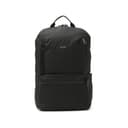
If your itinerary includes budget carriers, go further down: a personal-item-sizedpack around 30–35L that is soft enough to compress under a seat lets you fly the free allowance every time. That is a genuinely different way to travel — less packed, more mobile — and on a two-week multi-city trip it can save more than the cost of the bag.
The four things Europe asks of a bag that the US doesn’t
1. It has to be carried, not wheeled
Cobblestones, metro stairs without lifts, and fourth-floor walk-up apartments are the reason travel backpacks beat wheeled cases here. That makes the harnessmatter more than in any other trip type — a real hip belt is worth more in Rome than it is at O’Hare. Our backpack vs suitcase guide works through that decision properly.
The other European-specific habit is locking the bag. Hostel dorms, night trains and crowded metros are where a locked main zipper earns its keep, and it costs almost nothing on a bag you already own — how to lock a backpack covers the zipper mechanics and how to anchor a pack you have to leave.
2. It has to survive weather
Northern European rain is a genuine spec requirement, not a footnote. Look for a coated fabric or a bag whose maker states water resistance; a pack that soaks through means wet clothes for the next three days. None of the picks here are waterproof, and no travel backpack at this price is — a cheap packable rain cover is the honest fix.
3. It has to be unattractive to thieves
Pickpocketing in major European tourist centers is real and organized. This does not mean everyone needs a security bag, but it does mean your daypack deserves more thought than your main pack, because the daypack is the one open in a crowd. Lockable zips and a bag that sits in front of you on a crowded metro solve most of it; a slash-resistant pack solves the rest. More on that on our anti-theft roundup.
4. It has to work as a two-bag system
Nearly everyone traveling Europe ends up carrying a main bag plus a small day bag. Plan that deliberately rather than discovering it: either buy a pack with a detachable daypack, or pair a 35L main bag with a packable daypack that stows inside it. Two bags chosen together beat two bags accumulated separately.
What to leave at home
The most common European overpack is shoes and “just in case” layers. Both are volume-expensive and both are buyable there if you are wrong. The second most common is a bag that is too big for the trip you booked — if half your flights are budget carriers, the 45L pack you love is going to cost you a fee on each of them. Book the itinerary first, then buy the bag for the strictest carrier on it. That single ordering decision saves more money than any pick on this page.