How we chose these
Wheeled backpacks are an unusually noisy category. Most of what sells on Amazon under “rolling backpack” is a school bag with skate wheels, listed by a brand that publishes no dimensions, no empty weight and no warranty. Our criteria are deliberately narrow, and in this order:
1. Published external dimensions
This is the first filter and it removes most of the field. A wheeled bag has a rigid chassis, so unlike a soft backpack it cannot be squeezed to make a sizer. The number in the spec sheet is the number at the gate. Five of the biggest US carriers — American, Delta, United, JetBlue and Alaska — publish 22 x 14 x 9 inches, wheels and handles included. Southwest and Frontier are more generous at 24 x 16 x 10. The full airline-by-airline table lives in our carry-on size guide.
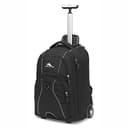
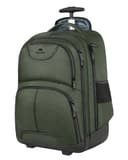
Two bags on this page publish figures inside 22 x 14 x 9: the High Sierra Freewheel, with margin on all three dimensions, and the MATEIN, which clears it on length and width and sits exactly level with it on depth. One bag sits exactly on the box. Two are over on at least one dimension. That distribution is the honest state of the category, and we would rather show it to you than pretend five bags all fit.
2. Empty weight
A wheeled bag starts about two pounds heavier than the equivalent backpack, and the spread here is large: 4.9 lb to 7.5 lb among the bags that publish a figure. On the US majors this rarely matters, because they publish no cabin weight limit at all. On Emirates and Qantas, where Economy is capped at 7 kg including the bag, a 7.5 lb pack has eaten more than a fifth of your allowance before you open it. We work through the carriers that weigh and the ones that don’t in carry-on weight limits by airline.
3. Whether the harness is real
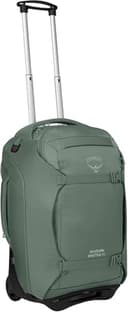
This is where the category divides cleanly. A real harness has a padded, tensioned back panel and a hip belt that transfers load onto your pelvis. Two flat straps sewn onto a suitcase do not, and above about 15 pounds the difference stops being subtle. Exactly one bag here — the Osprey Sojourn — has a genuine stowaway suspension with a hip belt. Every other pick has straps for short carries: up a stairwell, across a gravel car park, onto a train. That is a legitimate feature, but it is not the same feature, and listings blur the two constantly.
4. Published warranty
Wheels, handle and chassis are moving parts, and moving parts are what fail. A bag with a stated warranty is making a claim it can be held to; a bag with none has told you how long it expects to last. Three picks here carry a manufacturer’s warranty, one states a lifetime warranty on its listing and nowhere else, and one carries nothing.
Should you buy a wheeled backpack at all?
For most one-bag travelers, honestly, no — and we would rather say that on the page than sell you a hybrid you will resent. A 35–40L travel backpack is lighter, cheaper, fits sizers more forgivingly and has no parts to break. Our carry-on backpacks roundup is where most readers should start, and the wider argument is laid out in travel backpack vs suitcase. The other way to get wheels is to keep a plain roller and pair it with a personal-item backpack that rides on its handle; those are in best travel backpacks with a luggage sleeve — and if you have never been sure what that sleeve actually is, we explain it in what is a luggage sleeve. Where a wheeled bag genuinely is the right answer rather than a compromise is when carried weight is the constraint, which is the whole premise of best travel backpacks for seniors.
Buy a wheeled backpack when:
- A back, shoulder or knee injury makes carrying twenty pounds a real problem, but some legs of the trip have stairs or cobblestones a roller can’t handle.
- You commute with a heavy laptop kit and fly a few times a year with the same bag.
- You are packing for someone else — a child, a parent — who will alternate between rolling and being helped with the straps.
- Your trips are mostly airport-to-hotel-to-conference, with an occasional stretch of broken pavement.
Buy a plain travel backpack when:
- You fly weight-capped carriers, where two extra pounds of chassis is real money.
- You mostly walk with your bag: transit, stairs, old European city centers.
- You want the widest choice of bags that clear a sizer, which is far larger without wheels.
- You care about the bag lasting a decade, and would rather have no wheels to break.
If the reason you came to wheels was the sizer rather than your back, the strap-only field is worth a look first: carry-on backpacks that fit 22 x 14 x 9 applies the same published-dimensions test used above to plain packs, and several clear the box with margin on all three sides rather than sitting level with it — without spending two pounds of your allowance on a chassis.
The two High Sierras on this page are the decision most readers here actually face, and the cheaper one usually wins: the standard Freewheel publishes 19.5 x 13.5 x 8 in and a limited lifetime warranty, while the Pro adds six liters and goes over the standard box on width and depth with a five-year term instead. Our High Sierra Freewheel review and our High Sierra Freewheel Pro review put the two spec sheets side by side.
The mistakes this category invites
Assuming a rigid bag can be squeezed. Every piece of intuition you have about carry-on backpacks comes from soft bags, which bulge and compress. A wheeled bag has a plastic chassis and a wheel housing that do neither. If the spec sheet says 15.6 inches wide, it is 15.6 inches wide at the sizer.
Forgetting the wheels count.Airlines measure the widest point including wheels, handles and feet. A “17-inch” rolling backpack is 17 inches of bag, plus a wheel housing and a handle bar. Our how to measure a backpack guide covers measuring the way a gate agent will, and do wheels count in carry-on size sets out each carrier’s own wording along with every bag on this page measured against the standard box. The one bag here whose published packing figure is that box exactly is the Osprey Sojourn 45 — though Osprey publishes a second, larger exterior figure too, which our Osprey Sojourn 45 review works through. We also set it against a plain 40L pack in Farpoint 40 vs Sojourn 45.
Treating a stowaway harness as a nice-to-have. It is the feature that decides whether a hybrid survives being checked: with the straps, back panel and belt zipped behind a cover, the bag goes down the belt smooth-sided. Can you check a backpack as luggage covers why that matters and how to prepare a pack that has no such panel.
Reading “carry-on” in a listing title as a claim.No airline or agency certifies bags, so “carry-on approved” and “flight approved” are marketing words with no test behind them. The only test is the maker’s published numbers against your carrier’s published numbers.
Buying the biggest one.A wheeled bag will happily let you pack to forty-plus pounds because you are not carrying it — right up to the flight of stairs, the gravel path, or the gate agent who wants it in the sizer. The volume you can roll is not the volume you can lift into an overhead bin.
Skipping the personal item.None of these bags is comfortable to carry loaded for long. A small second bag for the laptop, documents and anything heavy makes the whole system work better — see our under-seat and personal-item picks.
Packing a wheeled bag differently
A wheeled backpack is packed like a suitcase, not like a backpack, and this trips people up. In a backpack you put dense items high and close to your spine, because that is where a harness can carry them. In a wheeled bag you put dense items low, over the wheels, because that is where the chassis carries them and because a top-heavy roller tips every time you let go of the handle.
The two rules collide the moment you convert. If you know a trip has a real carrying leg in it — a mile from the station, three flights of stairs — pack for the carry and accept a slightly tippy roll. Our how to pack a travel backpack guide covers the load-order logic in full.
The interior of most rolling backpacks is a single bucket with a laptop sleeve, which makes packing cubes more useful here than almost anywhere else: the chassis stops the contents from settling, so without cubes everything migrates toward the wheels on the first escalator. Two mediums and two smalls is the standard set for a bag this size.
Prices, and how we handle them
The spread on this page is wide — from a bag that costs less than a checked-bag fee to a premium travel pack several times that. Every price shown on the cards above is pulled live from the retailer and stamped with the date it was read; we never print a remembered number, and when a live price isn’t available the button says “check price” instead. Our full method is on how we choose.