How big is a weekender, really?
Roughly 25 to 35 liters. Below 25L you are into overnight-bag territory, which works for one night with no shoes; above 35L you have bought a travel duffel and should read our duffel roundup instead.
The useful comparison: our top pick is a published 26.5L, which is a genuinely small bag — two or three outfits, a pair of shoes and a wash kit. If you are packing for four nights and expecting to fit it in a weekender, you will be disappointed by every bag in this category. Size to the trip you actually take most often, which for most people is Friday to Sunday.
The shoe compartment is the whole feature
It sounds trivial. It is the single biggest difference between a weekender and a duffel with a zip. A separate, usually vented compartment accessed from the end of the bag means the pair of shoes you’re not wearing rides with its soles away from your shirts, and it stays accessible without unpacking anything.
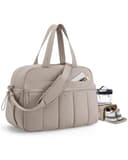
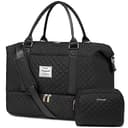
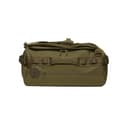
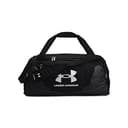
The Herschel and the LOVEVOOK have one built in. The BAGSMART solves it a different way, shipping with a separate zip shoe bag in the box, which keeps the soles off your shirts just as well and washes more easily. The Baboon and the Under Armour have a compartment that does the same job by another name — the UA has a vented pocket that’s explicitly for shoes or damp laundry. If a weekender you are looking at elsewhere doesn’t have one, you will end up buying shoe bags anyway, which is fine and costs about ten dollars. Our how to pack shoes guide covers the whole problem.
If you would rather have the compartment in a backpack than a duffel, it is a much shorter list — only a handful of travel packs state one, and most of the packs we rank highest do not. The ones that do are in best travel backpacks with a shoe compartment, which also explains why the feature is almost entirely a budget-brand thing.
Will it fly free? The honest answer
This is where the category gets slippery. Nearly every listing describes itself as a “personal item” bag, and most of them publish no dimensions at all. That is a claim, not a specification, and you cannot check it before it arrives.
Our top pick is the exception: Herschel publishes 17 x 10.75 x 9.75 inches for the carry-on Novel. Put that against a typical personal-item allowance like United’s 17 x 10 x 9 inches and the picture is clear — it’s a whisker over on two dimensions, which on a soft bag not packed to bursting normally passes, and which is exactly the kind of judgment you can only make when the numbers exist. It sits comfortably inside a full carry-on allowance of 22 x 14 x 9. The full write-up, with every published figure, is our Herschel Novel carry-on duffle review.
For the bags that publish nothing, our carry-on read is stated as ours, based on the style and the seller’s described use. Measure it yourself when it arrives, write the numbers on a note in your phone, and check them against your airline on the size guide. That takes two minutes and removes the only real risk in buying a cheap weekender.
What you get as the price goes up
The spread in this roundup runs from about the price of a takeaway to well over a hundred dollars, and the money goes to three places.
Fabric and hardware. The cheapest bags use light polyester and unbranded zips; the zip is what fails, and it fails at the corner of the shoe compartment where the bag flexes most. Mid-price bags use heavier recycled polyester and better pulls. The premium end uses coated, abrasion-resistant fabric that shrugs off wet ground.
Published information. This correlates with price more strongly than anything else. Established brands publish dimensions, materials and compartment layouts; budget sellers publish adjectives.
Structure.A reinforced base is the difference between a bag that stands up when you put it down and one that collapses onto the wet floor of a train vestibule. It doesn’t show in photos and you notice it constantly.
What the money does not buy is capacity. All of these hold a weekend. Pay more only if you use the bag often enough that build and structure matter.
Weekender vs backpack for a short trip
A weekender wins when you’re going door to door — car, train, hotel — and want a bag that looks like luggage rather than gear. It also wins for packing, because a wide zip on a soft rectangle is the easiest thing in the world to fill.
A backpack wins the moment you’re walking more than a few hundred meters, navigating stairs, or carrying anything heavy: a hand-carried bag puts the entire load on one shoulder and one side of your spine. Most weekenders here include a removable shoulder strap, which helps and does not solve it. If your weekends involve real walking, look at a 26L travel daypack in our daypack roundupinstead — same volume, carried properly. The broader version of that argument is in travel backpack vs duffel.
The wet pocket, and why it matters more than it should
A lined, separate pocket for wet or dirty things sounds like a gimmick until the weekend has a pool, a beach or a gym in it. On a two-night trip you are not doing laundry, so anything damp travels home with your clean clothes — a lined pocket is the difference between that being fine and it being a problem. It is the cheapest useful feature in this category, and the budget pick has one while several considerably more expensive bags don’t.
The mistake buyers make
Buying a weekender to be a stealth carry-on for a week-long trip. It won’t be: 30L of soft bag with a shoe compartment eating one end is a weekend’s clothes, full stop. If you need a week in one bag, you want a 35–40L travel pack from our main roundup and a set of packing cubes, not a bigger duffel.