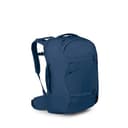
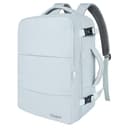
How to choose a women’s travel backpack
Fit is torso length, not the label
The single most useful thing to know: measure your torso, not your height. Torso length is the distance from the bony bump at the base of your neck (the C7 vertebra) down the curve of your spine to the shelf of bone at the top of your hips. Most adults land between 15 and 21 inches, and harnesses are built around three bands — under about 17 in (short), 17–19 in (regular) and over about 19 in (long).
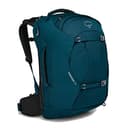
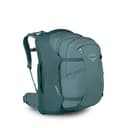
If you sit in the short band, a women’s-fit harness like the Fairview’s will carry better than a standard one: the hip belt lands on your hip bones instead of below them, and the straps don’t splay off your shoulders. If a standard pack already fits you well, you don’t need the women’s version, and if you measure over 19 inches you actively don’t want it — in which case the standard-harness picks on our men’s travel backpacks roundupare the ones to read, because “men’s” there means the regular and long fit bands rather than anything about who carries the bag. Our torso fit guide walks through the measurement, our Farpoint vs Fairview comparison shows the same bag in both harness lengths, and our carry-on picks by torso size sort the field into those three bands directly.
What actually changes on a women’s-fit pack
It is worth being specific, because “women’s” is used to mean anything from real engineering to a colorway. The genuine changes are:
- A shorter back panel. The frame is physically shorter, so the hip belt sits on the iliac crest rather than hanging below it. This is not adjustable — it is the reason the two versions exist.
- Narrower, S-curved shoulder straps. They clear the chest rather than pressing across it, and they anchor closer together so they stay on narrower shoulders instead of sliding outward under load.
- A differently angled hip belt. Shaped for a wider, lower pelvis, so the padding wraps the bone instead of pinching above it.
Everything else — capacity, fabric, zips, warranty — is normally identical to the standard version. If a listing advertises a women’s fit and none of the three changes above are described, you are most likely looking at the same bag in a different color.
When not to buy the women’s version
Three honest cases. If your torso measures over about 19 inches, buy the standard harness — the Farpoint 40 is here for exactly that reason, and it is the same excellent bag. If you are buying a bag under about 25 litres with no frame and no hip belt, harness length barely matters and you should choose on strap comfort instead. And if a budget pack’s “women’s fit” is unexplained on the listing, treat the claim as decoration and judge the bag on its specs.
Size to the trip and the airline
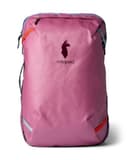
35–40L covers a week of carry-on travel; a 35L like the Cotopaxi Allpa clears strict sizers more easily than a 40L. Only step up to the 55L combo for longer trips, and remember its full size isn’t carry-on-legal — it is a 40L pack plus a 15L zip-off daypack, which is a two-bag setup, not a bigger carry-on. Check any pack’s external dimensions against your carrier on the size guide before you buy, and note that the Fairview’s narrower body (a stated 21.3 x 13.8 x 9 in) sits inside the standard 22 x 14 x 9 in allowance where the Farpoint’s 21 x 15 x 10 in relies on being soft.
What the budget end costs you
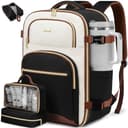
A 40L women’s pack with three packing cubes in the box for under fifty dollars is a genuinely good way into one-bag travel, and we’d rather say that than pretend everyone needs a premium harness. What you give up is specific: a real frame and load transfer, refined strap padding, published external dimensions you can check before you fly, and a warranty. That trade is fine for short walks between taxis and trains with a light load. It stops being fine at twenty minutes of cobblestones with 22 lb on your back.
Don’t forget the second bag
On most standard fares the main pack is only half the setup — you also get a personal item that lives under the seat with your travel-day essentials. Strap geometry matters more than harness length at that size; our personal-item picks for women cover it, including what to do on a personal-item-only fare.
The mistake buyers make
Choosing on capacity or looks and ignoring the harness. A beautiful 40L pack that doesn’t fit your back is a bag you’ll dread carrying, and no amount of strap adjustment fixes a frame that is the wrong length. Get the fit right first; everything else is secondary.