Passage & Pier

Best Packing Cubes for Backpacking

A backpack is a tube, not a drawer, and a set of cubes cut for a suitcase fights it the whole trip. Which cubes suit a pack, how much weight they cost, and how many to actually carry.

By Stephen V.Last updated How we choose

Most packing cube sets are designed around a suitcase: a flat rectangle you fill in layers, where a big cube lies down neatly and everything is visible when you open the lid. A travel backpack is a different shape problem. It is deeper than it is wide, it is often loaded from the top rather than the front, and every cube you add brings its own fabric, zip and seam allowance into a bag where liters are already scarce.

So the answer for backpacking is not “the best cubes” — it is smaller cubes, fewer of them, and at least one that compresses. The picks below are chosen on that basis, and the sections after them cover the two things that matter more than which brand you buy: how many cubes to carry, and what a set costs you in weight on a carrier that weighs your bag.

How this is funded:we earn a commission if you buy through our links, at no extra cost to you. It never changes which bag we recommend, and we’ll tell you when we’d skip one. Full disclosure.

Quick picks

Ranked on capacity, carry-on fit and who each bag actually suits. Select a row to jump to the full write-up. We have not flown every one of these — here is exactly what we do instead.

#ProductBest forPrice
1
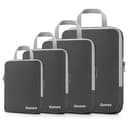
Gonex Compression Packing Cubes (4-Piece)

Gonex Compression Packing Cubes (4-Piece)

The best-value way into compression cubes. A double-zipper design expands to pack, then zips down to squeeze the air out — reclaiming real space for soft, bulky clothes. The build is budget, but the mechanism works, which is what matters.

Best overall for a pack
$16.99 · View on Amazon

$18.9911% off

Price as of September 4, 2026. #ad How we’re funded

2
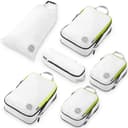
BAGAIL 6-Set Packing Cubes

BAGAIL 6-Set Packing Cubes

The value benchmark. A six-piece set of well-made mesh-top cubes at a price that makes 'just try packing cubes' a no-brainer — this is the set most people should start with. Not compression, but for organizing a carry-on it does everything you need.

Best value set
$18.99 · View on Amazon

$21.9914% off

Price as of September 4, 2026. #ad How we’re funded

3
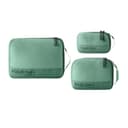
Eagle Creek Pack-It Reveal Cube Set

Eagle Creek Pack-It Reveal Cube Set

The premium organization pick. Ultra-light, water-resistant cubes with large mesh windows and grab handles, from the brand that popularized the category, backed by a lifetime warranty. Not compression — you pay for build, light weight and the guarantee.

Best sizes for a 35-40L pack
4
TRIPPED Compression Packing Cubes (6-Piece)

TRIPPED Compression Packing Cubes (6-Piece)

A step up in build from the budget compression sets — lighter fabric, better zippers, sized specifically around carry-on packing. The pick if you compress on every trip and want cubes that survive it, without paying premium-brand prices.

Best build for long trips
$39.94 · View on Amazon

$49.9520% off

Price as of September 4, 2026. #ad How we’re funded

The picks in full

#1Best overall for a pack

Gonex Compression Packing Cubes (4-Piece)

The best-value way into compression cubes. A double-zipper design expands to pack, then zips down to squeeze the air out — reclaiming real space for soft, bulky clothes. The build is budget, but the mechanism works, which is what matters.

Strengths

  • Second zipper genuinely compresses the load down
  • Expands roomy for packing, cinches small for carrying
  • Inexpensive for compression

Trade-offs

  • Budget zippers take the strain of compression — treat them gently
  • Best on soft, squashable clothes; useless on rigid items
TypeCompression packing cubes
Compresses to save spaceYes
MaterialNylon
Best forCompressing bulky clothes, Fitting more into a carry-on

Fit note. Compression cubes only shrink what can be shrunk — t-shirts, fleece, socks and puffies compress; jeans and shoes don't. Used on the right clothes, a four-piece set can free up a whole extra outfit's worth of room.

Specs read from the product listing, on July 21, 2026. “Not published” means the maker does not state that figure.

#2Best value set

BAGAIL 6-Set Packing Cubes

The value benchmark. A six-piece set of well-made mesh-top cubes at a price that makes 'just try packing cubes' a no-brainer — this is the set most people should start with. Not compression, but for organizing a carry-on it does everything you need.

Strengths

  • Six sizes cover a full carry-on's worth of sorting
  • Mesh tops let you see what's inside without opening
  • Genuinely inexpensive for the quality

Trade-offs

  • Standard cubes, not compression — they organize, they don't shrink
  • Basic zippers versus premium sets
TypeStandard packing cubes
Compresses to save spaceNo
MaterialPolyester with mesh tops
Best forOrganizing a carry-on, First-time cube users

Fit note. Standard cubes keep a bag sorted and make security and hotel unpacking painless; they don't save space the way compression cubes do. For most one-bag travelers, organization matters more than the extra squeeze.

Specs read from the product listing, on July 21, 2026. “Not published” means the maker does not state that figure.

#3Best sizes for a 35-40L pack

Eagle Creek Pack-It Reveal Cube Set

The premium organization pick. Ultra-light, water-resistant cubes with large mesh windows and grab handles, from the brand that popularized the category, backed by a lifetime warranty. Not compression — you pay for build, light weight and the guarantee.

Strengths

  • Lightweight, water-resistant build with big mesh windows
  • Eagle Creek's No Matter What lifetime warranty
  • Easy-grab zipper pulls and handles

Trade-offs

  • Premium price for standard (non-compression) cubes
  • Organization, not space savings — bulky loads still need compression
TypeStandard packing cubes
Compresses to save spaceNo
MaterialRecycled ripstop, water-resistant
WarrantyEagle Creek No Matter What lifetime warranty
Best forLong-term organization, Warranty-backed gear

Fit note. If you want cubes you'll still be using in ten years, the lifetime warranty and light, tough fabric justify the price. If you mainly want to squeeze in more, spend less on compression cubes instead.

Specs read from the product listing, on July 21, 2026. “Not published” means the maker does not state that figure.

#4Best build for long trips

TRIPPED Compression Packing Cubes (6-Piece)

A step up in build from the budget compression sets — lighter fabric, better zippers, sized specifically around carry-on packing. The pick if you compress on every trip and want cubes that survive it, without paying premium-brand prices.

Strengths

  • Sturdier zippers and lighter fabric than budget sets
  • Sized around carry-on dimensions
  • Well regarded for durability in its price range

Trade-offs

  • Pricier than the bargain compression cubes
  • Still relies on soft, compressible contents to earn its keep
TypeCompression packing cubes
Compresses to save spaceYes
MaterialLightweight nylon
Best forFrequent compression packing, Carry-on optimization

Fit note. The extra money over a bargain set buys zippers that hold up to being cinched down trip after trip — the part that fails first on cheap compression cubes.

Specs read from the product listing, on July 21, 2026. “Not published” means the maker does not state that figure.

Why suitcase cubes fight a backpack

Open a clamshell travel pack and you have a rectangle roughly 21 x 14 x 9 inches. A large suitcase cube is often 17 or 18 inches on its long edge, which means it fits one way round and only one way round. Once it is in, everything else has to work around it, and the corners it cannot reach are dead space — typically a liter or two you paid for and cannot use.

In a top-loading pack the problem is worse, because you are stacking rather than laying out. A tall stack of two mediums is stable and searchable; a single large cube wedged sideways means unloading the bag to reach anything under it.

The practical rule: in a 35–40L pack, medium and small are the only sizes that earn their place. Buy a set for the mediums and smalls and leave the large ones at home. That is true of every set on this page, including the six- and eight-piece ones — the extra pieces are spares and options, not a packing plan.

How many cubes to carry

Four, assigned by category rather than by size:

  • Tops— shirts and t-shirts, folded or rolled, in a medium.
  • Bottoms and layers— trousers, a mid-layer, in a second medium.
  • Small items— underwear, socks, a swimsuit, in a small.
  • Laundry— a compression cube, which shrinks as it fills with things that no longer need to look good.

That fourth one is the trick that makes cubes genuinely worth carrying in a backpack. Dirty clothes are the ideal compression candidate: you do not care if they wrinkle, and compressing them buys back the volume the clean clothes are steadily vacating. Run it that way and your bag stays roughly the same fullness all trip instead of overflowing by day four.

More on the system in how to use packing cubes, and the prior question — whether to carry any at all — in are packing cubes worth it.

The weight, which nobody prints

A set of cubes is not free. Fabric, zips and pulls add up to a real figure, and on a carrier that caps cabin bags at 7 kg it comes out of your clothing allowance before you pack a single item. Almost no cube maker publishes a per-piece weight, which is why our spec tables read “Not published” on that row rather than guessing at one.

What you can control is the count. Four cubes instead of eight is the single largest saving available in this category, and it costs you nothing you will miss. The airline-by-airline cabin weight table is in carry-on weight limits by airline.

Compression cubes in a backpack

Compression cubes have a second zip that squeezes air out after the cube is full. In a backpack they are more useful than in a suitcase, for a specific structural reason: a pack has no rigid shell to hold shape, so a compressed cube actually makes the whole bag smaller rather than just leaving a gap inside a hard case. On a soft 40L bag facing a strict sizer, that is the difference between a bag that clears and one that bulges.

The trade is wrinkles, and it is real. Compress knitwear, fleece, laundry and anything you will not be photographed in; do not compress a shirt you need to look pressed. The full comparison, including true compression bags, is in packing cubes vs compression bags.

What to look for in a cube for a pack

  • Mesh tops or a window. In a bag you cannot lay open on a bed, seeing the contents without unzipping is worth more than in a suitcase.
  • A grab handle on the short edge. This is how you extract a cube from a deep pack without unloading the ones above it.
  • Soft, unstructured sides.Stiffened cubes hold a rectangle you have to accommodate. Soft ones deform into the pack’s curves, which is what you want in a bag with no flat walls.
  • Zips that run past the corners. A zip that stops short means you are posting clothes through a slot rather than opening a lid.
  • Water resistance if you swim. A damp swimsuit in a coated cube is a one-cube problem. In an uncoated one it is a bag-wide one.

The honest case against

Cubes buy order, not space. In a backpack they cost you a little volume and a little weight, and they give you back the ability to find a t-shirt on day nine without excavating. For most people that trade is easily worth it; for a genuinely ultralight traveler carrying five days of clothing in a 26L pack, four cubes are four cubes too many and a single stuff sack does the job. Buy the number that matches the bag, not the number that comes in the box.
Frequently asked questions

Are packing cubes good for backpacking?

Yes, with two adjustments: use smaller cubes than a suitcase set suggests, and carry about four rather than the six or eight that come in the box. A backpack is deeper than it is wide and has no rigid shell, so large cubes waste corner space and a compressed cube genuinely shrinks the whole bag rather than just freeing space inside it.

What size packing cubes for a 40L backpack?

Mediums and smalls. In a 35-40L pack a large suitcase-sized cube fits one way round only and leaves dead corners around it. Two mediums, one small and one compression cube covers a full wardrobe; the large cubes in most sets belong in a suitcase or at home.

How many packing cubes do I need for a backpack?

Four, assigned by category rather than by size: tops, bottoms and layers, small items, and one compression cube for laundry. Adding more mainly adds fabric, zips and edges to a bag where liters are already scarce — and it stops being a system once you have to remember what's in cube six.

Do compression cubes work better in a backpack than a suitcase?

Structurally, yes. A suitcase has a rigid shell, so compressing a cube leaves an air gap inside a box that stays the same size. A soft backpack has no shell, so compression makes the whole bag physically smaller — which on a 40L pack facing a strict sizer can be the difference between clearing it and not.

Do packing cubes add weight to a backpack?

Yes, and almost no maker publishes the figure — which is why our spec tables say 'Not published' rather than guessing. It matters on carriers that weigh cabin bags, where a 7 kg allowance includes everything. The fix isn't a lighter brand, it's carrying four cubes instead of eight.

Sources

Keep reading