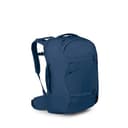
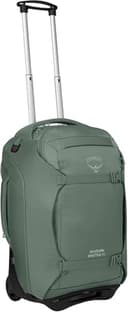
The numbers, side by side
Four published figures decide this, and all four are the makers’ own.
- Capacity.Farpoint 40L, Sojourn 45L. Five liters is roughly a pair of shoes or a bulky sweater — real on a cold-weather trip, irrelevant in summer.
- Published dimensions. Farpoint 21 x 15 x 10 in; Sojourn 22 x 14 x 9 in. The Sojourn is inside the standard US box on all three. The Farpoint is over on two of the three, which is the single most important thing comparisons of these bags tend not to mention.
- Empty weight. Farpoint 3.1 lb, Sojourn 7.93 lb. The difference, 4.83 lb, is more than the entire empty weight of a budget 40L pack.
- Laptop. Farpoint publishes a 15 in sleeve. Osprey publishes no laptop sleeve for the Sojourn at all, so on that bag the computer lives in your personal item.
Both carry the All Mighty Guarantee, Osprey’s any-product, any-era free-repair promise, so the warranty cancels out of this decision. So does the brand: whatever you think of Osprey’s build applies equally to both bags.
Why the heavier bag is the compliant one
A rigid wheeled case uses an airline allowance more completely than a soft pack does. The Sojourn is built to 22 x 14 x 9 in and holds that shape whether it is empty or stuffed, which is how Osprey fits 45 liters inside the box. The Farpoint has no frame, so its 40 liters bulge: packed hard it measures its published 15 in of width and 10 in of depth, and against a rigid sizer that is an inch over on each.
In practice this rarely bites on the US majors, because a soft bag that obviously fits the bin does not get measured. It bites on the carriers that measure as policy — the European budget airlines in particular, where Ryanair’s priority cabin bag is 55 x 40 x 20 cm and easyJet’s large cabin bag is 56 x 45 x 25 cm, both enforced at a frame. If your itinerary includes an intra-Europe hop, read our carry-on size guide before you count on a packed Farpoint, and measure the bag you own the way a gate agent would with how to measure a backpack.
Where the weight actually hurts
On the US majors, cabin bags are not weighed, so 7.93 lb costs you only your own comfort. Elsewhere it is a hard constraint. Emirates allows one Economy cabin bag of 7 kg (about 15.4 lb) and Qantas does the same on international Economy: the empty Sojourn is more than half that allowance before a shirt goes in, while the empty Farpoint is about a fifth of it. Lufthansa’s cabin allowance is 8 kg. On those carriers the Sojourn is a bag you must pack light, which argues against its own extra five liters.
Frontier is the friendliest combination for this bag: a 24 x 16 x 10 in box with a 35 lb limit, so the Sojourn fits with room and 7.93 lb still leaves 27 lb for clothes. Our carry-on weight limits guide has the carrier-by-carrier figures, and how much does a travel backpack weigh puts both of these bags on one table with every other published weight on the site.
The harness question, answered honestly
Most wheeled backpacks give you two shoulder straps sewn onto a hard case; they exist so the listing can say “backpack.” The Sojourn is the exception we have found: Osprey publishes a stowaway AirScape harness, backpanel and padded hip belt that deploy from behind a zip. That is a real suspension, and it is the whole reason this bag is worth comparing to a Farpoint.
It still is not the Farpoint’s harness, because it cannot be. You carry the wheels, the chassis and the telescoping handle on your back along with the clothes, so a loaded Sojourn is close to five pounds heavier than a loaded Farpoint holding the same trip. For station stairs, a cobbled street or a kilometer to a guesthouse, that is the difference between inconvenient and miserable. Treat the Sojourn’s harness as an escape hatch rather than the default mode and the bag makes sense; buy it expecting to carry it half the time and you have bought the wrong bag.
Who should buy which
Buy the Farpoint 40 if you walk any meaningful distance with your bag, you fly carriers that weigh cabin baggage, you want the laptop in the main bag, or the price difference matters. It is also the better bag for mixed terrain, which in Europe means most of the trip. Our Osprey Farpoint 40 review has the full write-up, and Farpoint 40 vs Cotopaxi Allpa 35L settles it against the other obvious carry-it option.
Buy the Sojourn 45 if rolling is the plan and carrying is the exception, you need the extra five liters, you want a bag whose published dimensions you can show a gate agent, or you cannot carry a loaded pack at all. If that is you, read best wheeled carry-on backpacks for the rest of the class and Sojourn 45 vs Transporter 40 for the wheels-versus-duffel version of the same argument.
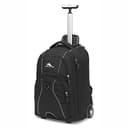
Buy neither if money is the constraint.The High Sierra Freewheel is the third pick above for a reason: at a published 19.5 x 13.5 x 8 in it is inside the standard box on every dimension with room to spare, it has the 15 in laptop sleeve the Sojourn lacks, and it carries High Sierra’s limited lifetime warranty. It is 34L rather than 45L, 5.5 lb rather than 7.93 lb, and its straps are for crossing a terminal rather than carrying a load — but it is a fraction of the price and it will not be stopped at a sizer.
What we are not claiming
We have not flown either bag. Everything above is published spec read against published airline policy, which is what that method is good for: fit, weight and warranty are knowable before you buy, while wheel durability over three years is not. Where a maker’s figure disagrees with its retail listing we say so on the card itself. Our standards, including what we refuse to assert, are in how we choose.