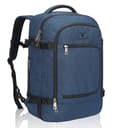
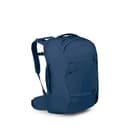
The published figures, side by side
- Capacity. 40 L both, fixed. The Hynes Eagle adds compression straps to cinch a light load down; the Farpoint has them too.
- Empty weight.2.2 lb against 3.1 lb. The Hynes Eagle is 0.9 lb lighter — 29 percent less bag before you pack anything. As capacity per pound: 18.2 L/lb against 12.9 L/lb. The Hynes Eagle is the lightest 40 L pack we cover.
- External dimensions. 20.1 x 13.4 x 9.8 in against 21 x 15 x 10 in. The Hynes Eagle is nearly an inch shorter and more than an inch and a half narrower.
- Laptop. 15.6 in against 15 in. A small win for the cheap bag, and enough to matter if your machine is a 15.6.
- Material. Water-repellent polyester against nylon ripstop. This is the first place the price difference becomes real: ripstop nylon resists tear propagation in a way plain polyester does not.
- Warranty.Osprey’s All Mighty Guarantee — any product, any era, repaired or replaced free. Hynes Eagle: not published.We print “Not published” rather than guess, and the absence is itself the information.
Fit: the cheap bag is the more compliant one
This surprises people, so here it is bluntly. Against the standard 22 x 14 x 9 in allowance:
- Hynes Eagle 40L: height 20.1 in (1.9 in of margin), width 13.4 in (0.6 in of margin), depth 9.8 in (0.8 in over). One failure.
- Osprey Farpoint 40: height 21 in (1 in of margin), width 15 in (1 in over), depth 10 in (1 in over). Two failures.
Width is where the Farpoint gets caught, and it is the quiet reason it occasionally fails a narrow sizer when a bigger-looking bag walks through: at a published 15 inches it is wider than the limit before you pack it. Depth is where both get caught, and depth is the dimension airlines measure most reliably — measured the way a gate agent would, packed and at its widest, not empty and at its neatest.
Both are soft clamshells, so both compress. A half-packed Hynes Eagle at 9.8 in of published depth is a plausible 9 in; a hard-packed Farpoint at 15 in wide and 10 in deep is the one we would not take to Ryanair, whose priority cabin bag is 55 x 40 x 20 cm (about 21.7 x 15.7 x 7.9 in). Our 40L fit guide runs every 40-liter pack on this site through the same arithmetic.
What the extra money actually buys
A hip belt that carries, not a hip belt that exists
Both bags state a hip belt. They are not the same object. Osprey’s is a padded, load-bearing belt attached to a structured back panel, which is the mechanism that moves weight off your shoulders and onto your hips. A budget pack’s belt is usually webbing with light padding and no frame behind it, which stabilizes the bag without unloading your shoulders. Nobody publishes a number for this, which is precisely why it is invisible in a spec table — and it is the single biggest difference you will feel on a packed 25 lb bag over an hour on your feet. Our hip-belt roundup separates the packs whose maker states a real belt from the ones with two courtesy webbing loops.
A warranty with no end date
Osprey’s All Mighty Guarantee is a free repair or replacement on any Osprey product, from any era, regardless of when or where it was bought. Hynes Eagle publishes no warranty term we could find. That is the difference between a bag whose failed zipper is a service ticket and a bag whose failed zipper is a new bag. Over ten years of regular travel, it is the strongest financial argument in the Farpoint’s favor; over three trips it is worth almost nothing. Our lifespan guide quotes every warranty on this site in its own words.
Materials that fail more slowly
Nylon ripstop against water-repellent polyester. Ripstop’s grid of reinforcing threads is designed to stop a small tear becoming a long one. Polyester is cheaper, a little heavier per unit of strength, and more UV-stable — it is not junk, it is just not the same thing. Combined with the warranty, this is why we describe the Hynes Eagle as a few-years bag rather than a buy-it-for-life pack, and say so on its own review.
The decision, in one number
Weigh your packed bag. Under about 20 lb, a load-bearing belt is a luxury and the Hynes Eagle is the better buy — lighter, slimmer, cheaper, and nearly a pound of allowance back on a 7 kg cabin limit. Over about 20 lb, or if you are walking more than twenty minutes with it, the Osprey’s harness earns its price on the first trip and keeps earning it.
The second question is time. If this is a bag for three trips, buy the cheap one and put the difference into the trip. If it is a bag for the next ten years, the guarantee is the cheapest insurance in luggage. Our spending guide works through the ladder rung by rung, and the under-$100 roundup is where the Hynes Eagle sits at the top.
The middle ground, if you want one
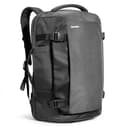
There is a third answer and it is a good one. The tomtoc 40Lpublishes 20.5 x 13 x 9 in — inside the standard box on height, width anddepth, which neither bag above manages — at 2.65 lb, with a 17.3-inch laptop sleeve, for a mid price rather than a premium one. Its belt is simpler than the Osprey’s and its brand has no All Mighty Guarantee behind it. If your deciding criterion is clearing every sizer you meet, it beats both of these on the only evidence available.