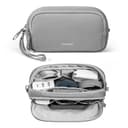
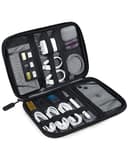
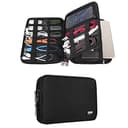
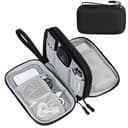
The four specs that actually matter
1. Does it close flat?
The most important property, and the one nobody lists. A case that bulges in the middle wastes far more space in a 35L pack than its own volume suggests, because it stops the items around it from lying flat — particularly a laptop, which wants a flat neighbor. Flat-closing is mostly a function of whether the case separates thick items from thin ones. Single-layer cases force a charging brick to sit on top of flat cables, which is exactly how the bulge forms.
2. Elastic loop width
Cases built for thin cables have narrow loops that will not hold a chunky international adapter or a modern GaN charger. The adapter then travels loose, and a loose adapter is the single item travelers most often arrive without. If your kit includes anything wider than a phone plug, check that at least a few loops are wide enough — or buy a case built around wide straps.
3. Size versus your actual kit
Buy for the kit you carry, not the biggest case available. A large case that travels half empty is dead volume you carry every day of the trip; a small case that won’t close means half the kit ends up loose anyway, which defeats the point. Lay out everything you actually travel with — laptop charger, phone cable, power bank, adapter, headphones, maybe a drive — and buy the case that fits that pile with a little room.
4. Padding, if you carry fragile things
Cables need no protection. Hard drives, camera batteries and glasses do. Padded cases cost a little more and take a little more room, and are worth it only if you’re carrying something that would actually break. Most people are not.
Peak Design is the only maker here that publishes an internal dimension as well as an external one, and the gap between them is the clearest number in this category: 9.5 x 6 x 4 in outside, 7.5 x 5.2 x 2 in inside. Our Peak Design Tech Pouch review works through what that structure buys and what it costs you in bag depth.
One case or two?
There is a good argument for splitting your electronics into twopouches rather than one: a small “daily” pouch with the phone cable, earbuds and power bank that lives in your personal item, and a larger “base” pouch with the laptop charger, adapters and spares that stays in the main bag. It means the thing you reach for hourly isn’t buried in the overhead locker, and it means the two never have to share a layout. Two cheap cases frequently beat one expensive one.
Where the pouch should live in your pack
Flat against the laptop sleeve, in the back panel of the bag. Two reasons: heavy items belong close to your spine, and a flat tech case is what keeps a laptop sleeve from being pressed into by everything else in the clamshell. Never put the tech case in an outer front pocket — it’s the heaviest small item you carry, and out there it levers the load away from your back and makes the whole pack feel heavier. The same principle drives our packing method, and the whole kit, from the laptop to the battery rules to the security lane, is packed step by step in how to pack electronics for travel.
What a tech organizer will not do
It will not save you space. Honest arithmetic: a well-packed case takes roughly the same volume as the same items packed carefully in gaps, and slightly more than cables shoved into shoes. The gain is order, not liters — the same honest framing we apply to packing cubes. Nor will it protect electronics from a real drop; that requires a hard case, which is a different product for a different problem.
Cut the kit before you organize it
The best tech organizer is a smaller pile of tech. Most travelers carry at least one redundant cable and at least one device charger they never use, because both were packed “just in case” and never audited afterwards. A modern multi-port GaN charger plus one cable per connector type replaces three or four bricks and their cables outright, and it is the single change that makes a small case sufficient. Organize second; reduce first.