What each bag publishes, and what it does not
This comparison is unusual in that one side of it is mostly blank, and we would rather say so than fill it in:
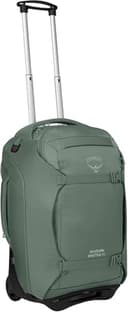
- Osprey Sojourn 45: 45L, 22 x 14 x 9 in, 7.93 lb empty, recycled high-tenacity nylon and ballistic polyester, stowaway AirScape harness, backpanel and padded hip belt, 90 mm wheels on a HighRoad chassis, All Mighty Guarantee. No published laptop sleeve.
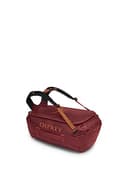
- Osprey Transporter 40L: 40L, water-resistant recycled nylon, wide U-zip opening, stowable backpack straps, All Mighty Guarantee. No published exterior dimensions, no published empty weight, no published laptop sleeve.
A missing figure is not a bad figure, but it does change how you shop. With the Sojourn you can do the gate arithmetic at your desk. With the Transporter you cannot, so the sensible move is to measure it yourself when it arrives — our how to measure a backpackguide works the same way for a duffel — and to pack it below full if you intend to carry it on.
The sizer behaves differently for each one
A rigid wheeled case is measured once and for all: the Sojourn is 22 x 14 x 9 in empty or stuffed, which is why it fits the box American, Delta, United, JetBlue and Alaska publish, and fits Southwest’s and Frontier’s larger 24 x 16 x 10 in with room. You never have to argue, and you never get a break either.
A soft duffel is the opposite. Packed two-thirds full the Transporter squashes into whatever frame it is pushed into, which is the duffel’s real carry-on advantage over a rigid bag of the same volume. Packed to 40 liters it is a different object, and on a carrier that measures as policy — Ryanair’s 55 x 40 x 20 cm priority cabin bag, easyJet’s 56 x 45 x 25 cm large cabin bag — a bulging duffel is exactly the shape that gets stopped. Decide which mode you are flying in before you pack, and read what happens if your carry-on is too big if the answer is “full.”
Weight is the Sojourn’s real cost
The US majors do not weigh cabin bags, so on a domestic trip the Sojourn’s 7.93 lb costs you only your own shoulders. On Emirates and Qantas, where international Economy allows one 7 kg (about 15.4 lb) cabin bag, the empty Sojourn is more than half the allowance — so the bag that holds five more liters is also the bag you cannot fill. Lufthansa publishes 8 kg. Frontier’s 35 lb carry-on limit is the generous case.
Osprey does not publish the Transporter’s empty weight, so we will not claim a number for it, but the structural point stands: there are no wheels, no chassis and no handle in it, and those are what the 7.93 lb is made of. If cabin weight limits are part of your flying life, the full carrier list is in carry-on weight limits, and how much does a travel backpack weigh puts every published weight on the site into one table.
Carry comfort: an escape hatch either way
Neither of these is a backpack first. The Sojourn’s harness is the best of its kind that we have found — Osprey publishes a real AirScape backpanel and a padded hip belt behind that zip — but wearing it means wearing the wheels too. The Transporter’s straps stow away neatly and are explicitly a get-across-the-airport feature rather than a suspension: no hip belt, no frame, no load transfer.
So if you expect to carry the bag for any real distance, both are the wrong answer and a proper travel pack is the right one. Start with best 40L travel backpacks or, if you want this same wheels-versus-carry decision argued between two packs, Farpoint 40 vs Sojourn 45.
Who should buy which
Buy the Transporter 40 if your trips involve rough transfers, you want one bag that flies and then gets thrown in a vehicle, you like a U-zip that lets you pack like a suitcase, or you simply do not want to haul wheels you will rarely use. The wider field is on best travel duffel bags.
Buy the Sojourn 45 if rolling is the default and carrying is the exception, you want published dimensions you can show a gate agent, or carrying a loaded bag is not available to you. The rest of that class is on best wheeled carry-on backpacks.
Buy the Eagle Creek Cargo Hauler 40L if the bag has to survive the trip. It is burly ripstop with taped, abrasion-resistant panels and it stays inside carry-on territory at 40L; its straps, like the Transporter’s, are for crossing a terminal. Eagle Creek publishes no dimensions or empty weight for it either, which is why the spec table above reads the way it does. If you want the two duffels compared directly, Cargo Hauler vs Transporter is that page.
What we are not claiming
No hands-on testing, no wheel-durability verdict and no invented weights or dimensions for the two bags whose makers do not publish them. What a specs-first comparison settles honestly is fit where it is published, weight where it is published, opening style, harness type and warranty terms. Our method, and the claims we refuse to make, are in how we choose.