Zip or drawstring? Zip, almost always
The drawstring bag is the one hotels give you, and it is the wrong design for travel. A drawstring closes to a gathered opening that never fully seals, so grit works its way out into the bag and the shoe works its way half out on the first hard jolt. It is fine for storing a pair in a wardrobe and poor at the actual job.
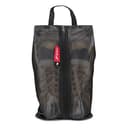
A zip closes completely, contains dirt, and lets you compress the bag flat by pushing the air out as you close it. The only case for a drawstring is a dress shoe you want to protect from scuffing rather than to isolate from your clothes — and even there, a soft zipped bag does the same thing.
Fabric: plain nylon or coated?
This is the one real decision, and it depends on whether your shoes will ever be wet.
Plain nylon is light, packs flat when empty, costs almost nothing and handles the ordinary case: dry shoes with dusty soles. Most people should buy this and stop reading.
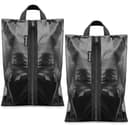
Coated fabric— TPU or similar — is the upgrade with one specific purpose, and it is the opposite of the one people assume. It is not there to keep rain out of the bag; it is there to keep moisture from a wet shoe in, on the leg home when the trainers got soaked on the last morning and there is nothing to do but pack them. Coated bags also wipe clean, which matters after a beach or a muddy walk. They cost more, come in smaller packs and pack less flat when empty.
The tidy solution, if you travel with more than one pair: a cheap nylon multi-pack for the normal shoes, and one coated bag reserved for whichever pair is wet.
Sizing, and the thing nobody prints
Shoe bags are sized, not scaled, and almost no listing publishes internal dimensions. The standard bag in a multi-pack is cut for a women’s shoe or an average men’s trainer. If you wear a large size, or you pack boots, hiking shoes or anything with a chunky sole, buy a set explicitly sold as large rather than assuming the fabric will stretch — it won’t, and a zip forced over a shoe that doesn’t fit is a zip you’ve broken.
The other sizing note: one bag per shoe is a real option and often the better one in a backpack. Two shoes in one bag makes a rigid block that has to be laid flat; one shoe per bag lets you slot each into the gaps at the sides of the pack, which is exactly where the dead space in a clamshell is. It costs you a bag and buys you usable volume.
How many do you need?
- Solo, one spare pair: one good pouch. A multi-pack is cheaper per bag and you will use one.
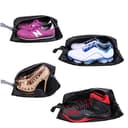
- Solo, two spare pairs (or one wet pair): a four-pack of nylon, or a two-pack of coated. This is the common case.
- A couple: a four-pack covers you both with a spare for laundry.
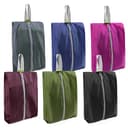
- A family:a six-pack, and the color-coded ones are genuinely easier — whose shoes are whose stops being a conversation.
Note the per-bag maths before you buy the “better” single pouch. A four-pack at ten dollars is $2.50 a bag; one good pouch at fourteen is fourteen. Both are defensible; they answer different questions.
Where the shoes actually go in the bag
Bagged shoes belong at the bottom of the pack, against the back panel, for two reasons. Weight close to your spine and low in the bag carries better, and the heaviest, hardest objects in a soft pack are what shape it — put them at the edges and the bag becomes lumpy in exactly the dimension a sizer measures.
The second habit worth adopting: stuff the shoes. Socks, underwear, a charger, a rolled belt. A pair of trainers contains close to a liter of air, and in a 35–40L bag that is real capacity. Bag the shoes with the socks already inside them and you have solved two packing problems with one zip. The full method is in our how to pack shoes guide.
What else these are good for
Shoe bags are the most reusable thing in a packing kit, and it is worth knowing before you decide how many to buy. They work as a laundry bagfor the underwear and socks you have worn — a coated one is better here for obvious reasons. They work for wet swimwear on a travel day. They hold a pair of sandals plus sunscreen as a beach kit, and muddy kit after a hike. If you already run packing cubes, think of shoe bags as the dirty-side counterpart: cubes keep clean things sorted, shoe bags keep dirty things contained.
Do you need them if your bag has a shoe compartment?
Less, but not never. A built-in shoe compartment — standard on a good weekenderand on some travel packs — is genuinely better than a bag inside a bag, because it’s accessible from outside and vented. What it doesn’t do is contain a wet shoe, and it doesn’t stop the compartment itself getting filthy. One coated bag inside the shoe compartment covers both, and costs less than a coffee.
“Some travel packs” is doing a lot of work in that sentence, so we went and checked which ones: the answer is a handful of budget Amazon bags and one premium exception, and almost none of the packs we rank highest elsewhere. The six whose makers actually state a dedicated shoe compartment are in best travel backpacks with a shoe compartment, with the sizes and the vent details for each. If your shortlist is a better pack without one, these bags are the fix.
The mistake buyers make
Buying a six-pack because it is barely more expensive than a four-pack, then packing six shoe bags. Empty bags are still fabric and still take space. Buy the pack size that suits your household, take the number of bags the trip needs, and leave the rest in the drawer.